Don’t Be Afraid Of Muskies
Muskies are fish of 10,000 casts and are found in large bodies of water in Northwestern Ontario.
By Gord Pyzer


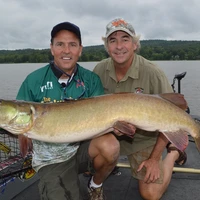


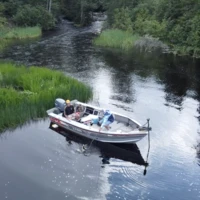


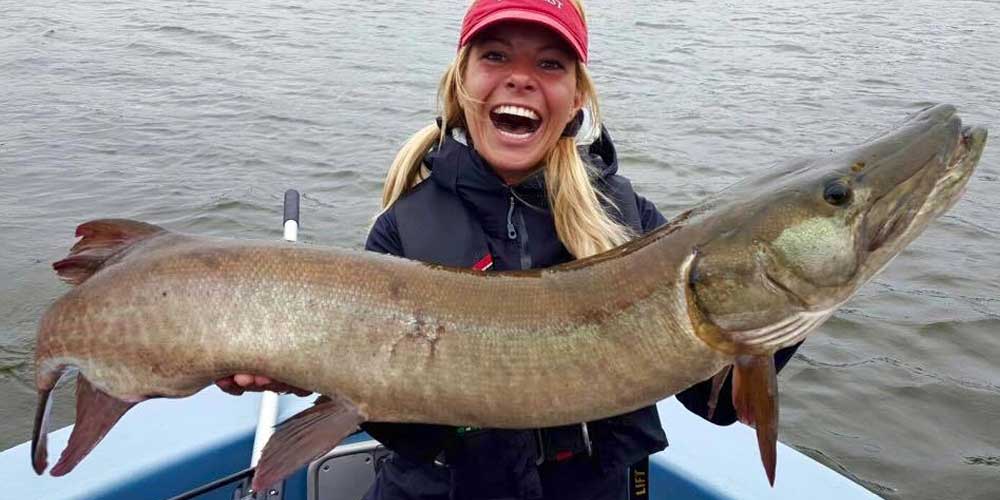
Ontario Canada is a dream destination for all musky anglers. Visions of giant muskies following lures from every shallow rock or weed patch, and a pair of big jaws striking a topwater lure is what keep us up at night. As musky hunters, we long for the opportunity to explore and conquer uncharted territories in search of the many trophy muskies that await our lure offering in Canada. There is no question that Ontario offers more opportunities to catch big muskies in shallow water than anywhere else in the world. However, that doesn’t mean it’s easy. The one thing about musky fishing is that even on the best musky waters, you are going to have to put in an effort to catch one. Fortunately, with many Canadian musky waters holding lots of shallow-water muskies, the odds are in your favour of catching a big one. Here are three surefire solutions to help you catch muskies in any Canadian water.of
Most Canadian waters are big. In fact, if you live in the US and have never fished in Canada, it could be some bays are larger than the entire lake you are used to fishing! Don’t let the large size of some waters intimidate you. Instead, use it to your advantage. Mainly, these large Canadian waters have more musky spots and more muskies.
My best advice is to break up large Ontario waters into easy pieces or fishable sections. Try and learn as many spots as possible in that section. Then move on to another section and learn that. Over time, you’ll know many great fishing spots and these large waters become more manageable. Plus, you save a lot of money on fuel. The more spots you learn in a given section the more muskies you will catch. It’s just better to spend more time fishing and less time driving between spots. When the muskies start biting, it’s much better to be able to fish several nearby spots with similar make-up rather than drive long distances between spots. You may only have a 30-60 minute window when the muskies are biting, and learning a specific area helps you maximize that time.
Another good idea is to focus on fishing smaller spots. As a general rule, you want to fish spots that take you 15-20 minutes to fish. Check out smaller islands where you can fish around the entire thing. When fishing larger islands, just focus on a point or a small bay. Stay away from large bays, or huge areas that may take too long to fish. Ultimately, you are trying to fish a bunch of spots and figure out the types of areas holding muskies. Once you figure that out, it’s simply a matter of replicating that same scenario, and Ontario waters frequently have nearby spots that look the same and will hold muskies.

Many Canadian waters have multiple navigation buoys or what I call “pins”. They can be red, green or black/yellow and mark shallow rock reefs, or shallow sandy areas that can have weeds. If you don’t know much about finding musky spots, let the pins do it for you. Any of the shallow areas marked by the pins are potential musky hot spots. If you see a pin, go fish it.
You will have to look at your map to note which side of the pin is shallow, but that’s the area to fish. It could be the pin is marking a rock reef, a rocky point, or a shallow sandy spot with weeds. Fish around that shallow cover and you’ll contact muskies.
Pay attention to the pin number so you can return it and more importantly what type of cover was on the spot. Was the shallow spot comprised of rock, weeds or both? Then go try and replicate it.
Sometimes shallow rocky spots are only marked with a jug. This is typical of shallow spots near lodges. Keep an eye out for them, because at times they are musky magnets. It amazes me how shallow the muskies can hold on such reefs. In fact, I always make it a point to cast to the top of the reef. Pins are great places to fish, just be careful navigating around them to avoid shallow hazards.
I catch at least 30 percent of my muskies every year at boat side by executing a figure 8 pattern with my lure. At our University of Esox musky schools at Sandy’s Blackhawk Camp on Lake of the Woods, some 60 percent of the muskies are caught on a Figure 8. So, if you are not executing the Figure 8 you might miss more than half of the muskies you could catch on a trip! Let that sink in for a second. In many situations, the Figure 8 can be more effective than the rest of your cast.
To execute the Figure 8 simply keep the same amount of line you need for your next cast, between your rod tip and the lure. For me, that’s about 18 inches. As the lure reaches the boat, move it in a large Figure 8 pattern making big turns or circles, the larger the better. Make the movements smooth and fluid and you can catch them. Just be sure and practice this every cast. That way, it becomes second nature. Once you feel comfortable with the transition between the cast and figure 8 and are making large turns, now practice hesitating or hanging the lure for a split second on the outside of the turns. This “hang move” triggers strikes on the Figure 8. It definitely takes practice, and if more difficult to do when a musky is following, but if you practice, you can convert it to memory and execute when a big toothy critter is behind your lure. There’s a big difference between executing a figure 8 with nothing behind it and looking down and seeing a 50-inch giant musky with its nose right behind the bait. Practice makes perfect in this case. You might still be nervous, but you might just trigger the biggest fish of your life to bite!
Ontario Canada offers endless opportunities to catch big muskies. Every island, reef, bay or point might hold a bunch of muskies or the fish of a lifetime. Check out visitsunsetcounty.com for some information on great musky lodges. When you are there consider the above solutions and go catch and release a giant.