Don’t Be Afraid Of Muskies
Muskies are fish of 10,000 casts and are found in large bodies of water in Northwestern Ontario.
By Gord Pyzer




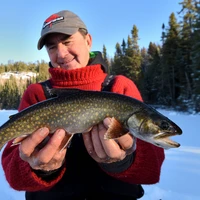






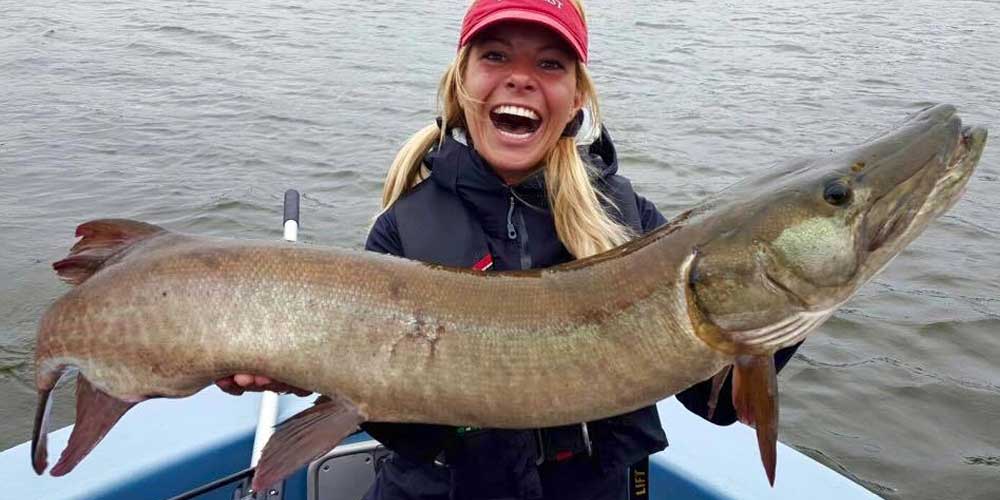
The muskie season is in full swing across Ontario — did you know the province has more muskie waters than anywhere else on Earth — and the fishing has been fantastic. So much so that Liam and I have been targeting the big toothy critters on a can’t-stay-away-from-them daily basis, instead of taking time off to chase bass, lake trout and walleye. And we’ve landed some impressive fish, including several big bruiser pike. Our secret: fishing glide baits.

When you hold a glide bait in your hand and examine it — the MKT Glide has been our workhorse this season — you will immediately notice two things. It feels heavy, and it doesn’t feature a spinner or lip to impart any action. That is your job, as glide baits are fundamentally sub-surface walk-the-dog-style lures. So when you pop your rod tip on the slack line, you can make them glide from side to side.

“I really like glide baits because they sink,” Liam says. “So, depending on the structure and cover you are fishing, you can count them down to the desired depth. However, I generally like to run them a couple of feet under the surface. This makes them the bait of choice any time you are fishing a relatively shallow structure or cover. Interestingly, too, even though they’re not weedless, they’re great for working over the top of weeds, or any type of sticky cover for that matter.”

Because muskie fishing is a hunting game, I normally start most days fishing with a double-bladed spinner to catch any aggressive fish and to gauge their mood. The first fish I raised the other day on blades, for instance, came in “low and slow” behind my spinner. That told me it was interested in eating, but not enough to attack the lure. So I grabbed the glide bait rod that I always have lying in the “on deck” position and sealed the deal on my third or fourth cast.

“Glides baits also work well during the low parts of an aggressive day,” Liam says. “What I mean by this is that if you’re fishing a dip in activity on an otherwise high percentage day, you can often trick a muskie with a glide bait.=

“But they really shine when the fish are in an eating mood, but not overly aggressive. You can present the lures at a snail’s pace if you choose, but even at normal speed, they’re still slower than most other muskie baits. This makes them perfect for catching the fish that want to eat, but don’t want to chase something speeding overhead.”
To get the most out of a glide bait — and present it properly — I like to use an eight-to-eight-foot six-inch heavy or extra-heavy action muskie rod, complemented with a fast ratio reel spooled with an 80-pound braid, so I can pick up line quickly. You will also find that many days, you’ll achieve the best gliding action not by using your rod tip, but rather by popping the reel handle quickly.

Finally, there are two leader setups that will help you ride the glide bait gravy train to multiple muskie successes. The first is a single-strand wire leader with no swivel or (my preference) an 8- to 10-inch section of 125-pound test Maxima monofilament that I tie directly to my main line using an Alberto knot. You may be surprised to learn that I favour monofilament over fluorocarbon for glide baits, but it is neutrally buoyant, so without the added weight of a swivel, the leader has no pull or drag effect on the gliding action of the bait.

If you’re new to the glide bait game, presenting the lures is not at all difficult, although it does require a little practice at first to develop the cadence to make the lure perform properly. The best way I find is to combine a sharp, fast turn of the reel handle with a small downward pop of the rod tip. If I see one mistake anglers make when they first start out, it is overworking the lure, when much shorter twitches would impart much better action. As I always like to say with glide baits, less is more.
Now, get out on the water and glide to success.