
20 Fall Views Away from the Crowds
Embrace adventure—it’ll be worth it.
By Nadine Robinson



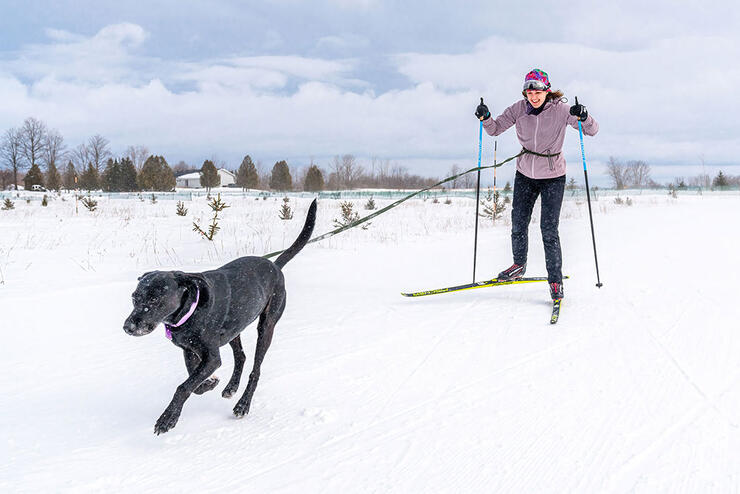
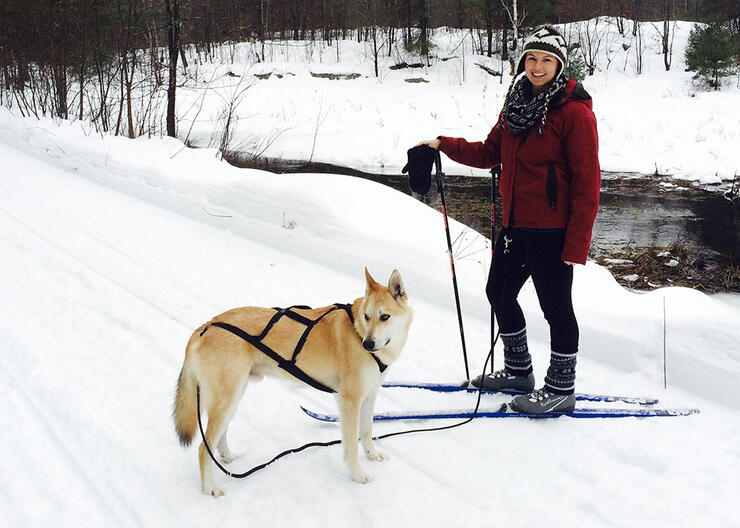
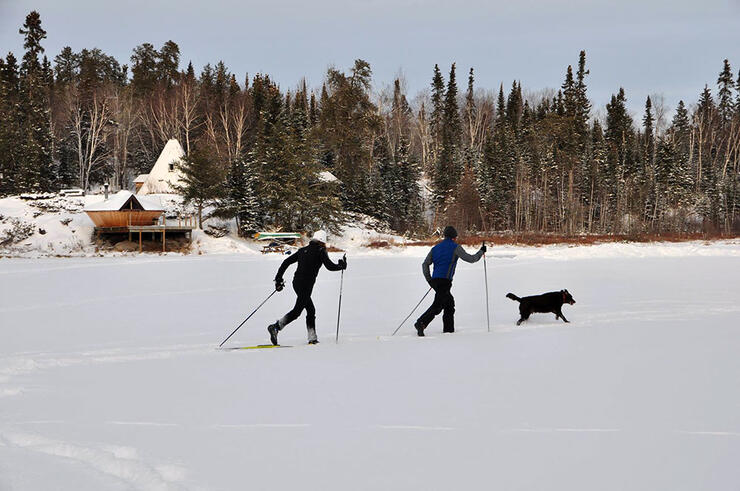
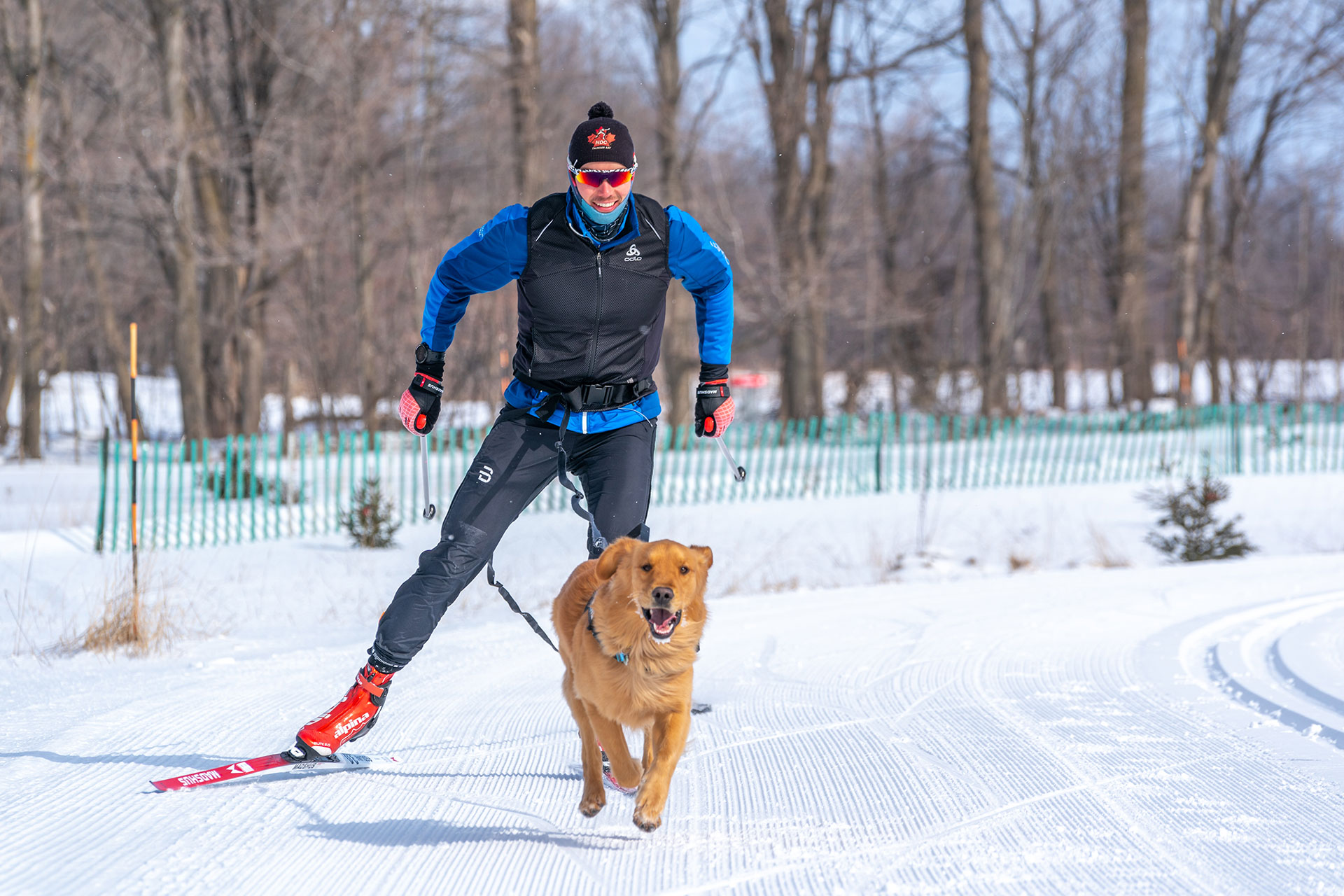
The first time you hear the term you’re bound to wonder: What is skijoring? In short, skijoring is cross-country skiing with your dog (or dogs) harnessed up to pull you along. Skijoring with dogs is a lot of fun, a great way for you and your four-legged friends to get some exercise and enjoy the snowy woods while developing your relationship.
Skijoring is like dogsledding, but a team of dogs is simplified to one or two, and the cumbersome dogsled reduced to a pair of speedy cross-country skis. Other than cross-country skis, bindings, boots and poles, skijoring-specific gear is simple and a full kit is often available for less than $100. You will need a dogsled-style harness for your dog, a tow-line (skijor specific models have a built-in shock absorber), and a padded waist belt.
You don’t need a husky to go skijoring. If your dog is larger than 14 kilograms (30 pounds), well-behaved and loves to run, it’s probably ready to skijor. To stay safe and maintain control over your dog, you should have at least novice cross-country skiing skills to try skijoring. Skijoring is especially fun (and fast) for those with advanced skate-skiing technique.
One of the biggest hurdles is finding where to go skijoring; dogs are not allowed at all cross-country ski areas, so it’s important to look for indications that skijoring is allowed. Check websites or call to ask. Golf courses, frozen lakes, multi-use non-motorized trails and urban parks also make excellent places to go skijoring with your dog in Ontario. Ontario Parks and other natural areas provide excellent locations to try it out, with several Ontario outfitters offering skijoring for beginners lessons.
To help you get started, we'll go over how to get into skijoring, as well as where to go skijoring in Ontario.
Skijoring with dogs can be fun for just about anyone, human or canine. The first criteria for skijoring for beginners is a well-behaved, reasonably fit dog. Mid-size dogs between 18 and 27 kilograms (40 to 60 pounds) are the easiest to handle, but your control and safety while skijoring ultimately boils down to your relationship with your pet (how well it responds to commands) and your ability to ski.
Beginner skijorers are advised to take a few introductory cross-country ski lessons sans-Fido to get a handle on the sport. Canicross, or trail-running with your dog, is a great way to condition your dog for skijoring without the added complications of slippery skis, awkward poles and icy hard-packed snow. Be sure you’re at least a novice skier before skijoring with dogs. You should be able to control your speed on downhills, negotiate corners and handle your poles confidently before you try skijoring with dogs.
Look for gentle trails and plenty of space for your first skijoring outing, and ideally try to avoid a busy time of day. Groomed trails are ideal, but make sure that dogs are allowed. Open areas with compacted snow like city parks work well, too, along with golf courses. A wider pair of entry level cross-country skis are ideal for trying it out, and will allow you to venture into areas where the snow cover is a little deeper.
As your dog discovers the freedom of running and pulling and you progress from a novice to intermediate skier, you may wish to try skate-skiing. This high-intensity style of Nordic skiing makes for exhilarating skijoring in the right conditions on groomed snow, especially if you have an athletic dog.
Any dog over 14 kilograms (30 pounds) can skijor. Iconic sled dog breeds like huskies and malamutes are often great pullers and naturally equipped to stay warm outside in the cold (and also make for the best pictures), but the truth is everything from golden doodles to spaniels and mid-sized Heinz 57 mutts can learn to be great skijor dogs—because just about every dog loves to run and play in the snow.
Ultimately, the most important criteria for skijoring with dogs is a well-behaved canine companion who listens to your commands. After that, the sport is as simple as encouraging your dog to run and overcoming the annoying tendency of some animals to make sudden sniff stops. Since you’re bound to meet other humans and dogs along the trail you’ll also want a dog that’s friendly and tolerant of others.

Regardless of the breed, it’s a good idea to wait until your dog is at least a year old (some vets and dogsledders recommend 18 months) before trying him or her out in a harness to allow their muscles and bones to become fully developed. Besides growing physically, these youthful days are also the best time for your dog to learn basic obedience skills.
For simplicity and control, skijoring for beginners is best with one dog. This is good advice for both the sake of humans and hounds, since more dogs increases the likelihood of tangles. As you develop your skills it’s possible to skijor with two or even three dogs. Speed increases with the number of dogs—as does the degree of difficulty in staying upright, keeping control of your poles and managing your team of dogs. If you have more than three dogs, you’re best to break off into several skijoring groups or try dogsledding.
You’ll need a pair of cross-country skis, bindings, boots and poles to skijor with dogs. Your skis don’t need to be high-performance; classic touring or track skis are adequate, and fish-scale or skin (no-wax) bases are ideal for ease of maintenance and use. You can also skijor on skate-skis if you have the appropriate skills and fitness.
You will need to fit your dog with an appropriate sized dogsledding harness for pulling; do not use your dog’s collar. Harnesses are sized based on the dog’s measurements, including the length of their back and width of chest, so be sure to try before you buy. Skier and dog are tethered with a towline (approximately three metres in length), ideally with a section of bungee for a shock-absorber. The towline is attached to the skier at a waist belt; wider is typically better in terms of control. Depending on your dog’s breed, they may benefit from a set of booties to protect their paws from slush and ice accumulation.
Harnesses, skijor towlines, waist belts and booties are available at specialty retail stores like Chaltrek in Thunder Bay, while AKKO Sports and Nahak offer online sales. You may also find harnesses and other gear at some pet stores across Ontario. Many skijorers make their own gear, including dog harnesses. Search online for plans.
Skijoring with dogs is a team sport and you’ll have to learn it together with your canine companion. Since most obedience training involves reprogramming your dog’s desire to run and pull and focuses on sitting, staying and heeling close, with skijoring you face the challenge of encouraging your dog to rediscover its independence—while still following your commands.
The easiest way to get started with skijoring is to recruit a friend (ideally a capable cross-country skier) to ski ahead and encourage your dog to chase, providing lots of positive reassurance and praise along the way. Start with short distances and make sure you always try to end skijoring sessions on a positive note to keep up your dog’s enthusiasm. Skijoring commands like “hike!”, “let’s go!” and “hup!” urge your dog to keep up the pace and avoid tempting smells (or other dogs) along the trail.
Skijoring commands to steer right and left are “gee” and “haw,” respectively. It takes plenty of practice to condition your dog to these instructions, and the best way is often to introduce them on leashed walks over time. Similarly, skijorers use the command “on by” to encourage their dog(s) to keep running past distractions along the trail. Again, this skill is easiest to teach on leashed walks around town. You can try to encourage your dog to slow down with a long, low “whoa,” but don’t expect to get an instant response if they’re running hard and having fun!
Always keep training sessions as positive as possible, providing lots of praise, pats and treats as rewards. Do your best to make your dog’s harness a signal of skijoring (and ideally fun), and insist they’re well-behaved and following commands whenever they are harnessed up.
As with any skill, you’ll shorten the learning curve to proficiency by taking a skijoring lesson or two. If you’re a beginner Nordic skier, it’s best to take a few introductory lessons without your dog to hone your cross-country skiing technique and make the skijoring experience safer and smoother for you and your dog.
Similarly, both you and your dog will benefit from basic obedience training before you set out on snow. If your dog is amply obedient, then try a more advanced class in agility to work on your pet’s independence, a critical trait for skijoring. Once you’re ready for a snowy adventure, options for Ontario skijoring lessons include the following:
Yours Outdoors offers comprehensive skijoring lessons in Ontario’s Haliburton region in January and February. Participants work with veteran competitor and instructor Karen Koehler to fast-track their skijoring skills. Level 1 training is a perfect introduction to skijoring for beginners with novice Nordic skiing experience and a dog who loves to pull. Level 2 focuses on more advanced skills to develop your proficiency.
Happy Tails offers beginner skijoring lessons in Huntsville all winter long. Private and small-group instruction is available, depending on your experience and ambitions. Happy Tails also offers intermediate lessons to develop specific skills and a full-day skijoring workshop to fast-track your development.
To streamline your search, we’ve identified some of the best places to skijor in Ontario. We’ve focused on Northern Ontario, but there are certainly plenty more opportunities for skijoring. Ottawa, for example, boasts one of Ontario’s most active dogsledding and skijoring clubs with dedicated trails available for members at Larose Forest, just south of the city. Check out canicross (trail running with your dog) or bikejoring (cycling with your dog) if you live in places with less reliable snow coverage.
Skijoring is allowed at this epic Northern Ontario cross-country ski destination, located about an hour east of Thunder Bay on Highway 587. You must be in control of your dog (a skijoring towline counts as a leash) to access Sleeping Giant Provincial Park’s 50 kilometres of groomed Nordic ski trails. There’s something for everyone at Sleeping Giant, including easy trails in the vicinity of Marie Louise Lake that are perfect for skijoring for beginners as well as the long and adventurous Pickerel and Burma loop trails, which venture far into the Park’s backcountry. The Sifting Lake Trail is a designated off-leash area. On-site accommodations include one pet-friendly cabin. You can also book a cabin at nearby Beyond the Giant Nature Retreat, located on Lake Superior’s Black Bay.
Plan your trip
One of Central Ontario’s preeminent Nordic ski areas offers a dedicated trail for skijoring. Arrowhead Provincial Park is located off of Highway 11, just north of Huntsville and about three hours from the GTA. A one-kilometre loop is groomed for you to discover the joys of skijoring with your dog. Make sure you book early to score Arrowhead’s only dog-friendly cabin and enjoy the rest of the Park’s winter attractions, including a popular skating trail through the forest. On-site cross-country skis rentals are available at the Visitor Centre.
Plan your trip
The Mattagami Region Conservation Authority administers the Hersey Lake Conservation Area, located five kilometres north of Timmins on Highway 655. You’ll find many trail options that are open in the winter for snowshoeing, cross-country skiing and skijoring with your dog—a popular destination for members of the Timmins Dog-Powered Sport Association. Better still, the Hersey Lake trails connect to the impressive 55-kilometre Timmins Recreational Trail Network, which is open to all forms of non-motorized use.
Plan your trip
Central Ontario’s Algonquin Provincial Park is undoubtedly one of the province’s most popular year-round outdoor destinations. In the winter the Park maintains a dedicated groomed trail for dogsledding and skijoring: The Sunday Lake Dog Sled Trail provides dozens of kilometres of skijoring opportunities, with multiple loops located off the Highway 60 corridor in the southern half of the Park. You can also check out the Old Railway Bike Trail for an ungroomed experience that’s best in shallower snow conditions. This wide corridor stretches from the Mew Lake Campground on Highway 60 to Rock Lake, offering 16 kilometres of skijoring potential with gentle hills and pleasant views. The Mew Lake Campground remains open year-round for winter camping, with one pet-friendly heated yurt available.
Plan your trip
Northwestern Ontario’s Quetico Provincial Park, located on Highway 11 near Atikokan, is an excellent destination for skijoring and dogsledding thanks to its groomed ski trails and the option of exploring vast frozen wilderness lakes, as well as the region’s epic winters. Start with the groomed ski trails at the Dawson Trail Campground, a good choice for beginner skijorers. More advanced skijorers may wish to set off across frozen water bodies (be sure to inquire about ice safety first), including Batchewaung Lake and Nym Lake. Snow conditions are often best for lake skiing in March, when sunny days and cold nights create a hard surface that’s perfect for skate-skiing with your dog.
Plan your trip
A 14-kilometre out-and-back backcountry ski trail to Mabel Lake is one of the most popular places to ski with your dog in Sault Ste. Marie. Dogs are not allowed on the immaculately maintained classic and skate-ski trails at the nearby Hiawatha Highlands, but the occasionally groomed Mabel Lake backcountry route is a perfect destination for skijoring. The first half of the trail is flat and twists in and out of boreal spruce bogs and a scenic wetland area. Get ready for some serious hills in the second half, where the trail climbs up and over the Canadian Shield to the remote shores of Mabel Lake. Access is via Connor Road, near the junction of Landslide Road and Sixth Line, about 15 minutes north of downtown Sault Ste. Marie. Although trail passes are not required, it is recommended that you stop at the Hiawatha Highlands in the Kinsmen Building to buy a day pass and support the maintenance of this excellent trail. Cross-country ski rentals are also available.
Plan your trip
This Mattawa-based resort welcomes adventurous humans and their four-legged friends with cozy, eco-conscious accommodations (including chalets, cabins, domes and yurts) and great trails for skijoring and snowshoeing. At Nature’s Harmony Ecolodge you can discover over 20 kilometres of well-groomed, dog-friendly trails in the rugged landscape surrounding the historic Ottawa River. A traditional wood-fired sauna is also available.
Plan your trip
The 16 kilometres of dog-friendly, well-groomed ski trails at Rushing River Provincial Park, located about a half-hour drive east of Kenora on Highway 17, exemplify everything that makes Northwestern Ontario such a skijoring paradise. You’ll find something for everyone, including flat trails for beginner skijoring, as well as longer loops and out and back trails up to six kilometres in length. It’s easy to fill an entire day exploring the area’s boreal forest, wetlands and lakes with your dog. A daily park pass is required to use the trails. Reach out to the local skijoring community on Facebook to join a group event.
Plan your trip
The Sudbury area boasts an abundance of cross-country skiing options, but you have to sift through to find dog-friendly trails for skijoring. Windy Lake Provincial Park, located 45 minutes northwest of downtown Sudbury on Highway 144, is a good place to start. The Park’s 15 kilometres of groomed ski trails are open to well-behaved dogs so it makes a good destination for skijoring in Sudbury. The trails are maintained by the Onaping Falls Nordics Ski Club, and ski rentals are available at the clubhouse buildings on weekends. Trail passes are required.
Plan your trip