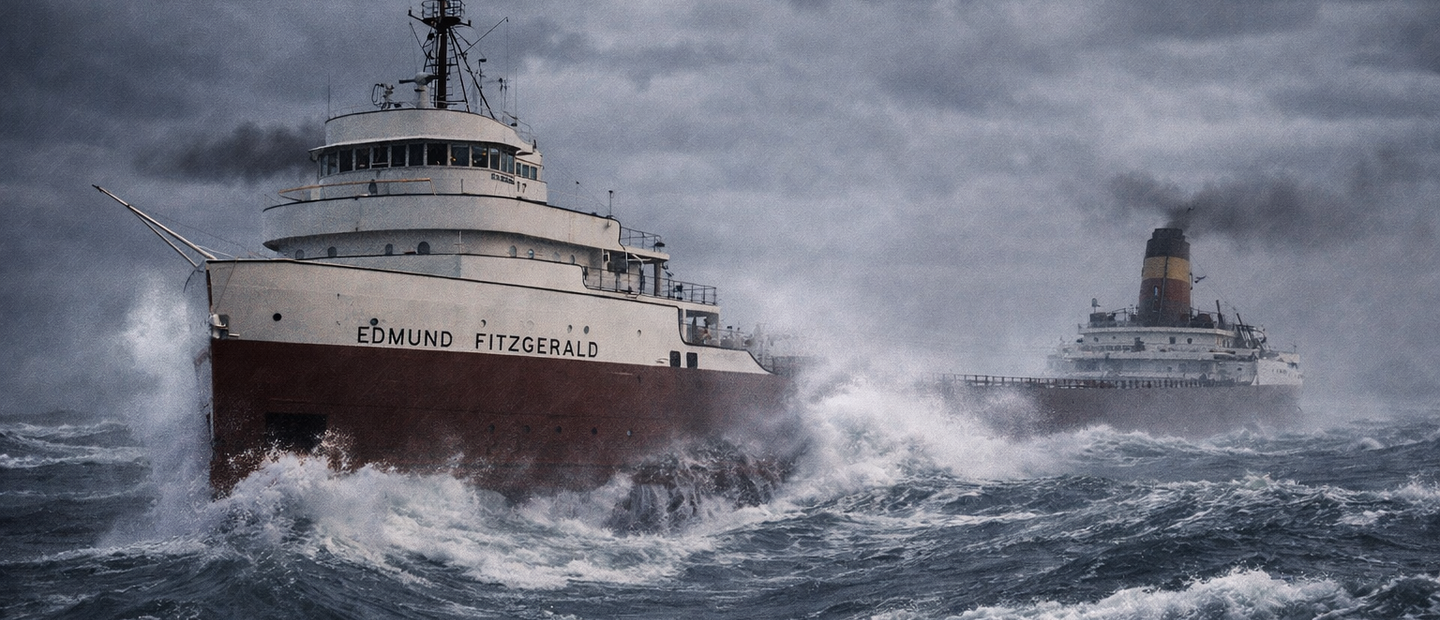
Great Lakes Shipwrecks: Tragedies on Lake Superior & Lake Huron

From the Edmund Fitzgerald to the long-missing Bannockburn, explore the stories of ships lost on Lake Superior and Lake Huron and the powerful storms that shaped Great Lakes history.

Tragedies on the Great Lakes

A scan of historical sources shows that there are literally hundreds of shipwrecks lying on the bottom of the Great Lakes. After all, these massive bodies of water, known for their intense storms, have been shipping lanes for at least two centuries. Two of the largest of the Great Lakes, Huron and Superior, have taken down many ships over the past two centuries, and the dangers presented by the "Gales of November" remain today. This article examines the stories behind some of those wrecks that have sunk in or near Canadian waters on Lakes Superior and Huron.

The SS Edmund Fitzgerald: The Most Famous Great Lakes Shipwreck

Just about everyone has heard of the SS Edmund Fitzgerald, wrecked in a massive storm on Lake Superior on November 10, 1975. The wreck is likely so famous because the story of its sinking was immortalized in the song "The Wreck of the Edmund Fitzgerald" by Canadian musician Gordon Lightfoot. Hauling a load of iron ore, "26,000 tons more than the Edmund Fitzgerald weighed empty," the ship departed Superior, Wisconsin, on November 9, 1975. While a warning was issued that an incoming storm off the Great Plains was approaching, the sheer size of the ship made it impossible to conceive that anything bad could happen. 

After leaving port, the Fitzgerald was joined on its journey by another freighter, the Arthur M. Anderson, which sailed behind the Fitz. The ships were about 10 miles apart and had communicated that they would travel along the northern part of Superior, which offered some protection from the storm. As the storm worsened, both ships struggled in the waves, reportedly 25 feet or more in height. The last communication from Ernest McSorley, captain of the Fitzgerald, to the captain of the Arthur M. Anderson was "We are holding our own." 
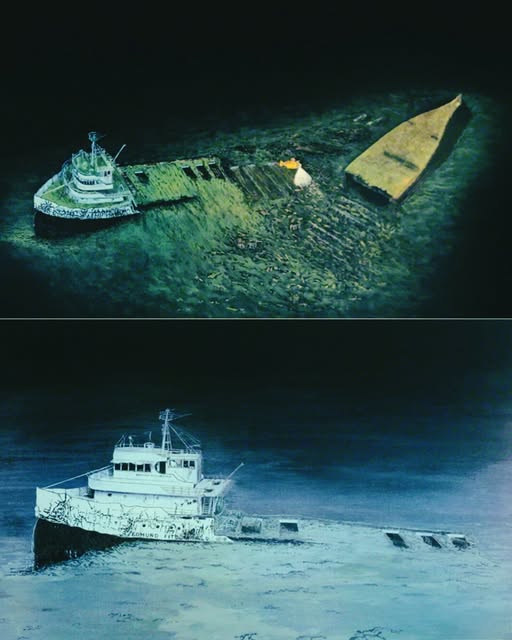
Artist rendering of the wreck site of the SS Edmund Fitzgerald.
The Edmund Fitzgerald lies 530 feet below the surface of Lake Superior in Canadian waters.

Just a half hour later, the ship disappeared from radar with no communication. This underscores the likelihood that the sinking event was catastrophic, with no time to send out an S.O.S. The cause of the sinking has never been fully settled and remains a subject of debate today. As the song lyrics say:

They might have split up or they might have capsized
They may have broke deep and took water
And all that remains is the faces and the names
Of the wives and the sons and the daughters...

SS Edmund Fitzgerald

  • Date shipwrecked: 10 November 1975.​
  • Approximate location: About 17 miles northwest of Whitefish Point, Michigan, in 530 feet (about 160 m) of water, in Ontario (Canadian) waters of eastern Lake Superior.
  • Depth of the wreck: Approximately 530–550 feet (technical-diving only, visited by ROV).​
  • Cause (likely): Foundered in a violent November gale; the U.S. Coast Guard’s official report emphasizes massive flooding through ineffective hatch closures, while other investigators highlight possible shoaling or structural failure. The exact cause remains a subject of debate.
  • Lives lost: 29 crew (all hands).
  • Rescue/search attempts: When radio contact was lost, Coast Guard units and nearby freighters (including SS Arthur M. Anderson) searched the storm area; a U.S. Navy aircraft later located the wreck using a magnetic anomaly detector.

The SS Kamloops: A Ghost Ship Lost to Ice and Storm

While technically lying in US waters on Lake Superior, the SS Kamloops was a Canadian freighter that met its doom in a severe snowstorm on 7 December 1927 off the shore of Isle Royale. All hands were lost. The wreck was considered a "ghost ship" for many decades because no one was sure what happened to it or knew where it sank. A horrible aspect of this maritime tragedy was the fact that some of the crew members survived the initial sinking and made it to Isle Royale, where they ended up freezing to death, their act of survival in vain. In fact, a female stewardess left a note in a bottle on Isle Royale that was found months later, stating that some crew members made it to shore. The wreck was finally spotted by a sport diver in 1977, off Isle Royale, about 260 feet below the surface of Lake Superior. 
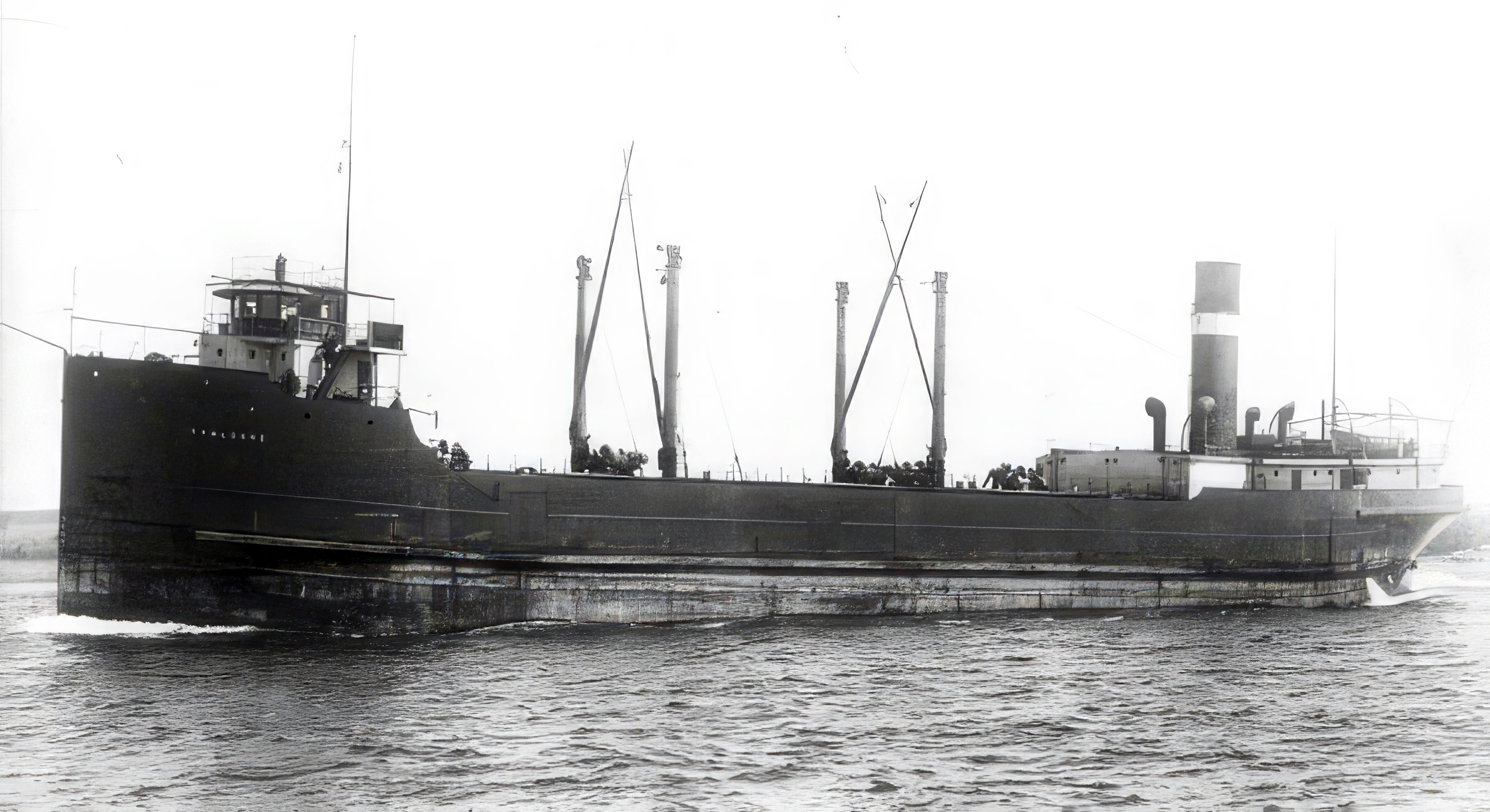
The SS Kamloops in 1925.
The SS Kamloops seen here in 1925. It sank in a storm on 7 December 1927.

SS Kamloops

  • Date shipwrecked: Around 7 December 1927
  • Approximate location: Off the northeast side of Isle Royale, in deep water on the north side of the island; the ship was Canadian-owned, but the wreck lies in U.S. waters.
  • Depth of the wreck: Roughly 260–270 feet (around 80 m), at technical-diving depth.
  • Cause (likely): Vanished during a severe early-winter gale after being seen heavily iced; likely foundered due to storm, icing, and possible cargo shift.
  • Lives lost: 22 crew (no known survivors).
  • Rescue/search attempts: Declared overdue when it failed to arrive; later, bodies and cargo washed ashore on Isle Royale. The wreck itself was not discovered until 1977 by sport divers.

SS Algoma: One of the Deadliest Early Disasters on Lake Superior

An early "screw steamer" on the Great Lakes, the SS Algoma was built in 1883 for the Canadian Pacific Railway Company and had a very short life, sinking just two years later in a storm on November 7, 1885. The Algoma was part of a Fleet of three passenger ships purchased by CPR to provide service between Owen Sound and Thunder Bay. The Algoma even set a speed record in 1885, taking just over 39 hours and 42 minutes from Owen Sound to Thunder Bay (Fort William in those days). 
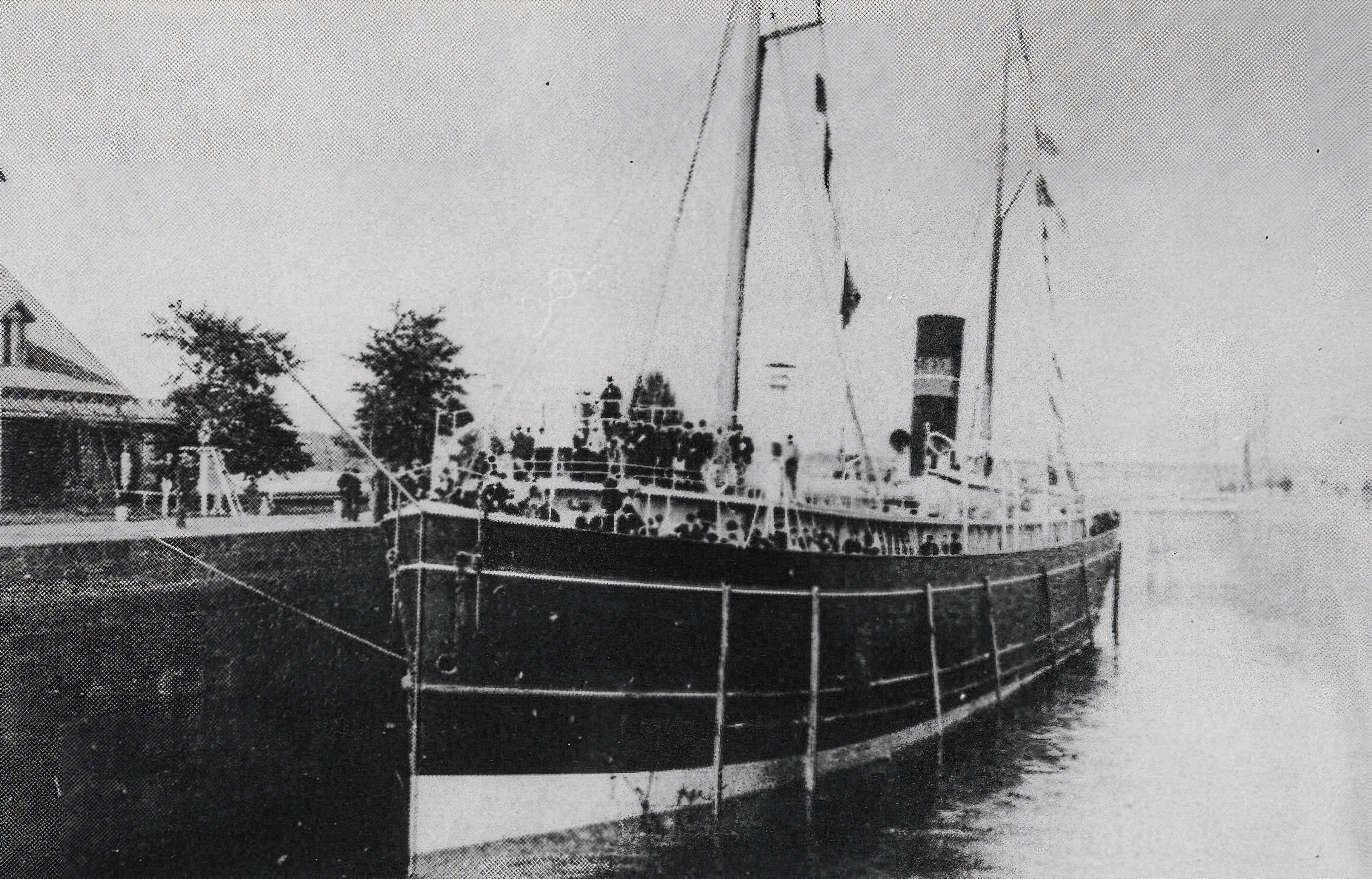
The SS Algoma Steamer in 1885.
The SS Algoma was a "screw steamer" built in 1883 and wrecked in 1885.

Like so many others, she met her fate in a November snowstorm, running aground on Greenstone Island near Isle Royale on Lake Superior. Smashed by the waves against the rocks, the Algoma literally split in two, with the stern breaking off and drifting away, drowning all persons in that section. Some were able to swim to shore while the bow stayed intact, on the reef, despite taking an incredible pounding from the waves. 46 people died, and there were 14 survivors. The wreck of the SS Algoma was the worst ever recorded loss of life on the Great Lakes up to that time.
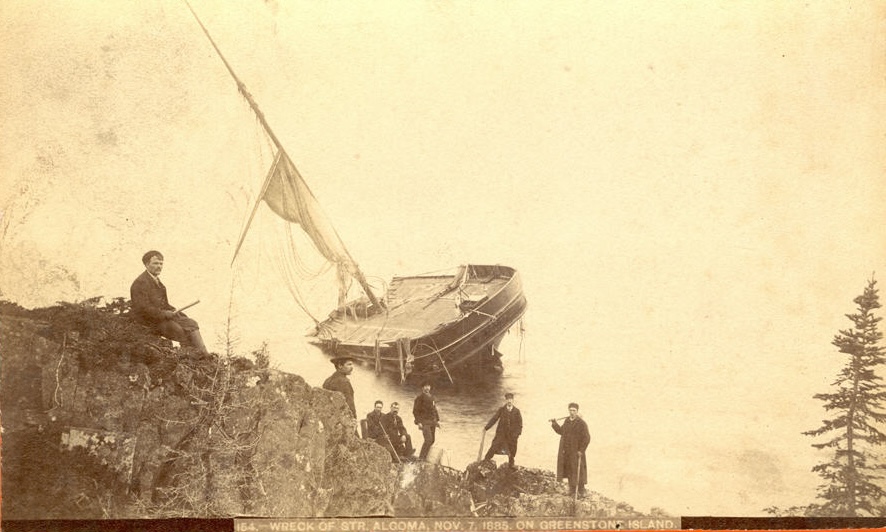
SS Algoma

  • Date shipwrecked: 7 November 1885
  • Approximate location: Eastern Lake Superior on the route between Owen Sound and the Lakehead, wrecked in a snowstorm on rocks near the north shore/Isle Royale region.​
  • Depth of the wreck: Portions of the wreck are reported in relatively shallow water off the reef where she struck; detailed depth varies by dive report and isn’t consistent across quick-reference sources (you’d want a dedicated dive chart here).
  • Cause (likely): Passenger steamer encountered a fierce snowstorm, lost visibility, struck rocks, and broke up in heavy seas.​
  • Lives lost: Roughly 46 deaths out of about 60 people aboard (exact counts differ slightly between historical accounts).​
  • Rescue/search attempts: Survivors made it ashore or were picked up by other vessels once the storm abated.
The wreck of the SS Algoma.
Image showing the bow section of the SS Algoma, wrecked on a reef. 46 people died in the shipwreck.

Shipwrecks at Point Mamainse: The William O. Brown and Charles Hebard

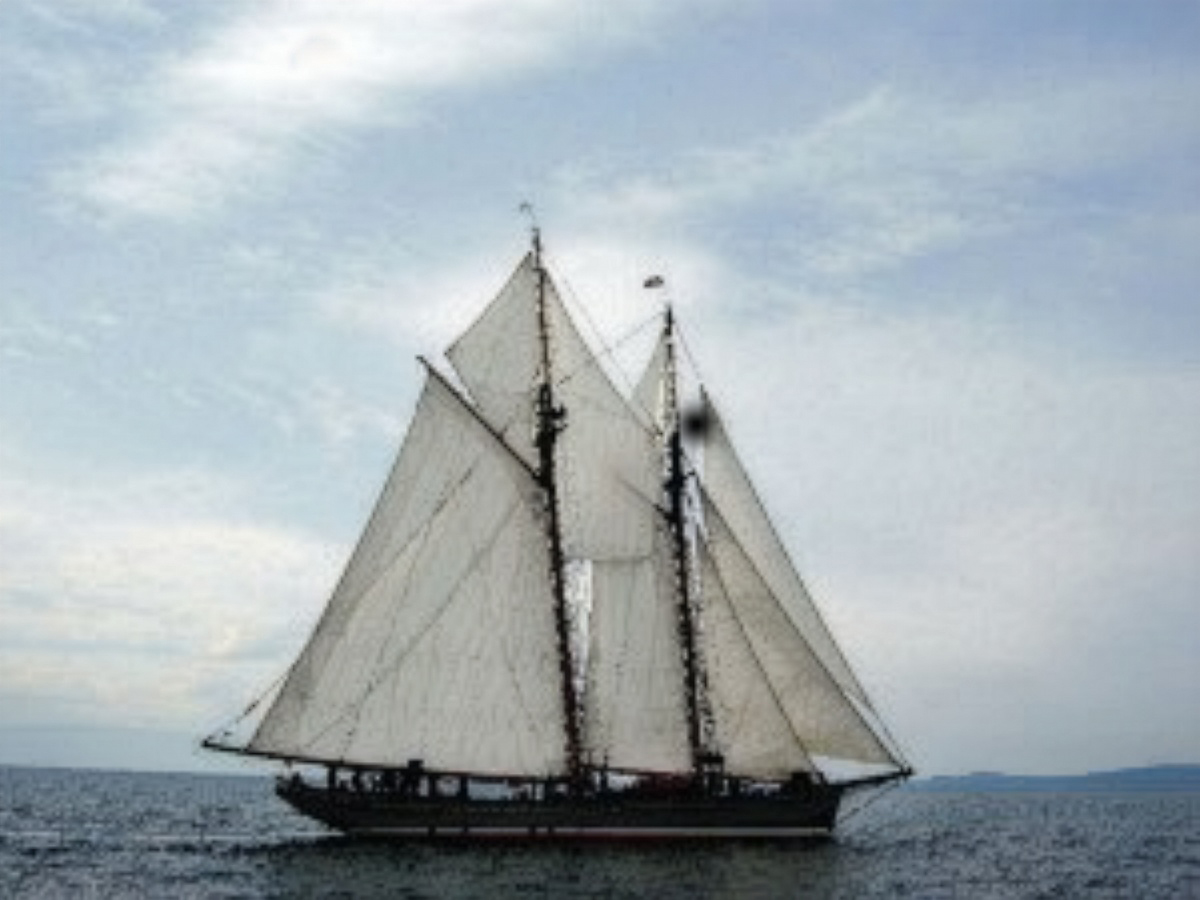
While these ships wrecked 30 years apart, they did so in the same place on Lake Superior, at Point Mamainse, located north of Pancake Bay. On November 27, 1872, very late in the shipping season on Lake Superior, the William O. Brown, a 400-ton wooden schooner transiting a load of wheat to Buffalo, ran aground on rocks off the point. Only 3 of 7 crew members survived, and the wheat never reached Buffalo. 

William O. Brown

  • Date shipwrecked: 27 November 1872.​
  • Approximate location: Off Mamainse, along Superior’s east shore north of Sault Ste. Marie, Ontario.​
  • Depth of the wreck: Grounded on nearshore rocks; the remains are in shallow water zones close to shore.​
  • Cause (likely): Wooden schooner, loaded with wheat, struck rocks in a night gale; a mast tore open the deck, the hull flooded, and the vessel broke in two.​
  • Lives lost: Two crew members washed overboard during the breaking of the ship; of those who reached shore, two died of exposure, bringing the total to four deaths.​
  • Rescue/search attempts: Survivors salvaged a small boat from the wreck, repaired it, and sailed to Batchawana Bay to reach a logging camp and help.

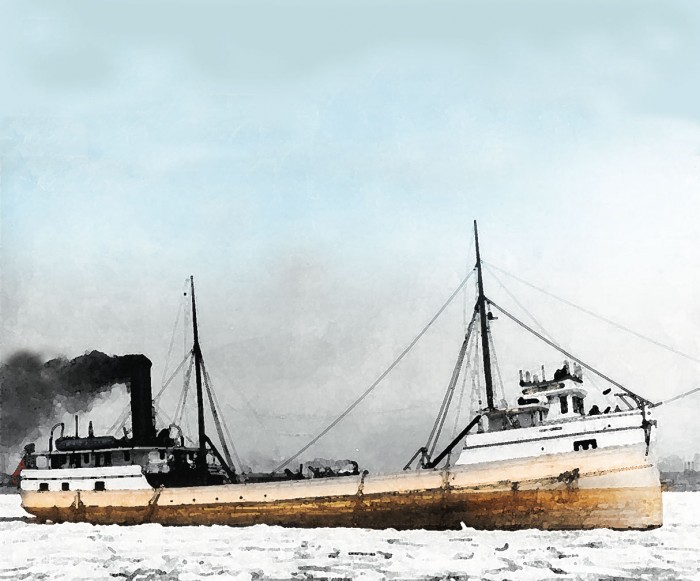
On the other hand, the Charles Hebard was a wooden steamship that foundered off Point Mamainse in a storm in December 1902. Thankfully, all 14 crew members made it to shore safely, and the lake claimed no victims that day. After an initial group from the ship made it to shore, they rigged a rescue chair on a rope and went out to the ship to save the rest of the crew, including the ship's female cook.
Charles Hebard

  • Date shipwrecked: December 1902
  • Approximate location: Point Mamainse on the eastern shore of Lake Superior, north of Pancake Bay, Ontario.​
  • Depth of the wreck: Nearshore, on shallow rock off the point; most of the vessel was broken up in the surf, with remains in relatively shallow water (exact depth varies by local account).​
  • Cause (likely): Wooden steamer caught in winter storm, driven onto rocks, and “dashed to pieces” by heavy seas.​
  • Lives lost: Accounts from Ontario Parks note crew making it to shore; no major loss-of-life figure is emphasized, suggesting most or all survived.​
  • Rescue/search attempts: Crew reportedly rigged a rope and “boatswain’s chair” from ship to shore, hauling remaining crew—including the cook—across the gap to safety.
Schooner William O Brown wrecked off Point Mamainse in November 1872 Wooden steamship Charles Hebard wreckd in 1902.
The William O. Brown (left) and the Charles Hebard were both wrecked in the same general area on Lake Superior.

The SS Bannockburn: The Flying Dutchman of Lake Superior

One of the most interesting of the lost ships on the Great Lakes is the story of the steel freighter Bannockburn. This 244-foot-long ship was built in England in 1893 and brought to Canada, where it was used as a Great Lakes freighter. The Bannockburn is of such interest largely due to the circumstances of her sinking and the fact that no one saw or heard any distress calls. Further, her wreck has never been found, and there is rampant speculation of where it might lie. Many think it is in some of the lake's deepest water, but ultimately, no one knows for sure. Called the "Flying Dutchman" of the lake, there have been reports of her sighting by modern ships even though she sank in November 1902. As time marches on, her story only grows more mysterious. Many believe that with modern technology, especially modern sonar imaging, her wreckage will eventually be found. Until then, the Flying Dutchman of Lake Superior continues to fascinate shipwreck enthusiasts.
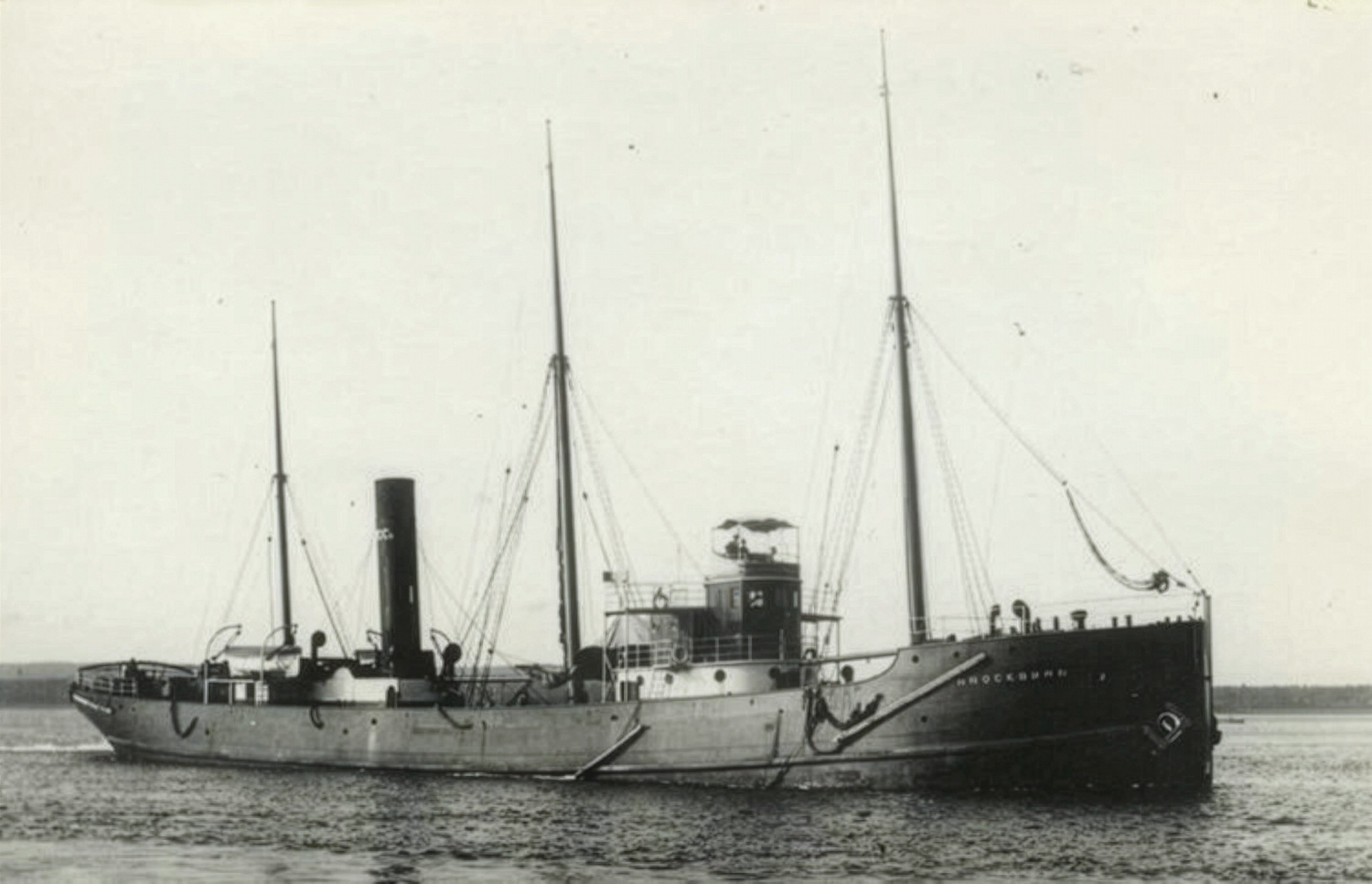
SS Bannockburn 

  • Date shipwrecked: 21 November 1902
  • Approximate location: Vanished on Lake Superior en route from Port Arthur (Thunder Bay) to Georgian Bay, generally believed to have gone down near Caribou Island and its surrounding reef in the eastern part of the lake.
  • Depth of the wreck: Unknown—the wreck has never been positively located, though searchers and historians suspect deep water around the Caribou Island reef system.
  • Cause (likely): Disappeared during a powerful November storm while carrying about 85,000 bushels of wheat; later investigation by underwriters concluded she probably struck the unlit reef around Caribou Island after the lighthouse there had been intentionally extinguished the week before.
  • Lives lost: About 20 men (all on board were lost, with no bodies recovered).
  • Rescue/search attempts: When Bannockburn failed to arrive at the Soo Locks, owners and authorities sent tugs to search the north shore and shipping lanes; another steamer (John D. Rockefeller) reported passing through a debris field off Stannard Rock, and only a single life preserver was definitively identified later on a Grand Marais beach.
The Flying Dutchman of Lake Superior.
The Bannockburn a.k.a. The Flying Dutchman of Lake Superior. Her wreck has never been found.

The SS Wexford and the Great Storm of 1913

Known for significant storms every year, the Great Lakes can often be a dangerous place to be, especially late in the season. Like other years before and after, 1913 saw its share of weather events, but one storm, known as The Great Lakes Storm of 1913 or, as it is often called, The Big Blow or also, The White Hurricane, was a blizzard with hurricane-force winds that hit the Great Lakes between November 7 and 10, 1913.  The storm was the deadliest natural disaster to ever hit the Great Lakes. More than 250 people were killed in its wake, and nineteen ships were destroyed, including the freighter, the SS Wexford.

The Wexford sank in Lake Huron, and the wreck itself wasn't discovered until 2000, even though it is in very shallow water at just 75 feet deep. It was a large freighter for its time, and when it sank, it was hauling 96,000 bushels of Canadian wheat. Nobody knows the exact circumstances of the big freighter's sinking, but given the severity of the storm, it was likely overwhelmed by waves and foundered, with the loss of all hands. Bodies of sailors from the Wexford washed up on the southeastern shore of the lake a couple of days later.   
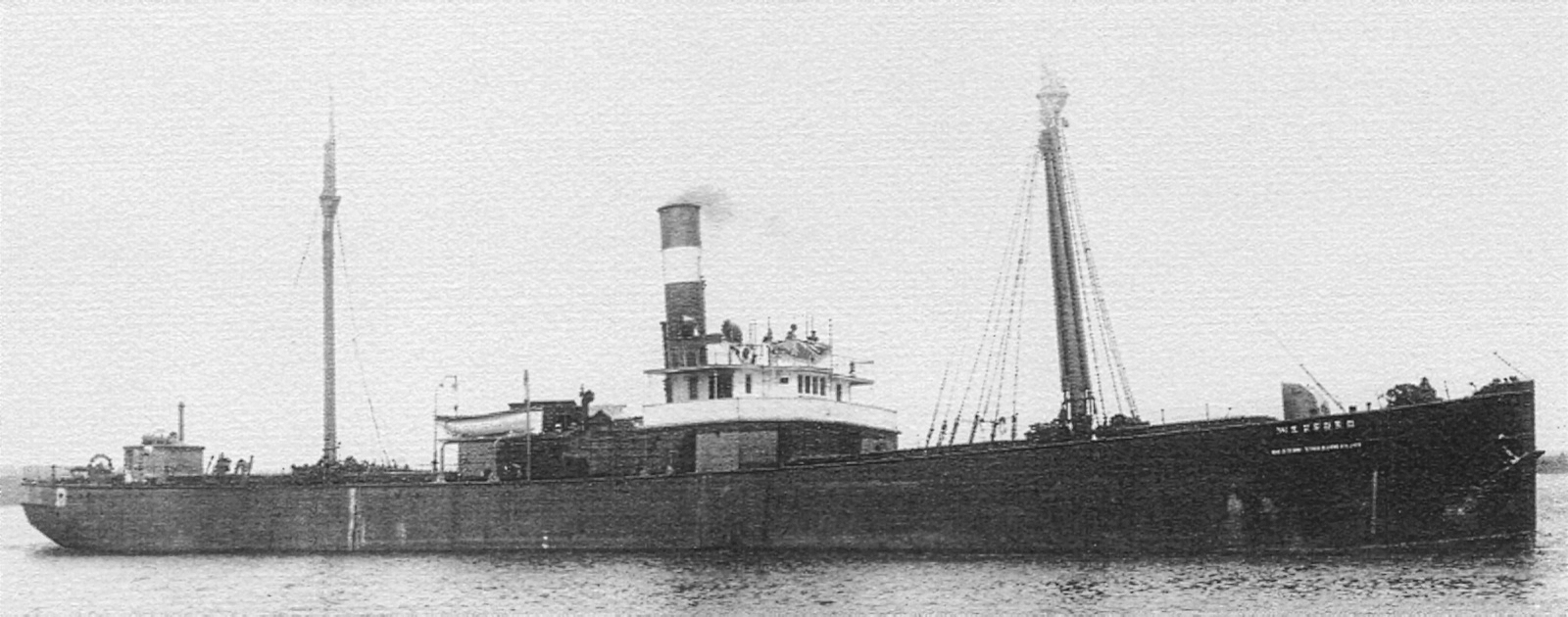
The SS Wexford lost in the Great Storm of 1913.
The SS Wexford - lost in the Great White Hurricane of 1913. A 3-day blizzard with 80+ mph winds. 

SS Wexford 

  • Date shipwrecked: 9 November 1913, during the Great Lakes storm of 1913.
  • Approximate location: Lake Huron off the Ontario coast; the wreck lies intact and upright at about 43°25′N 81°55′W, in Canadian waters off the southeastern shore of the lake.
  • Depth of the wreck: Approximately 75 feet (about 23 m) to the lakebed.
  • Cause (likely): Steel-hulled, propeller-driven cargo ship overwhelmed by the extreme winds and waves of the 1913 “Great Storm” while carrying 96,000 bushels of wheat.
  • Lives lost: All hands; sources give conflicting crew numbers, typically between 17 and 24 lost.
  • Rescue/search attempts: Wexford was one of several vessels that simply failed to arrive after the storm; wreckage and bodies washed ashore along the Lake Huron coast, but the ship itself was not located until 25 August 2000, when divers found the wreck sitting intact and upright on the bottom.

The James C. Carruthers: The Final Mystery of the 1913 Storm

After its discovery at the bottom of Lake Huron in May of 2025, the last victim of the 1913 Great Lakes Storm was finally found. In all, 19 freighters were lost over the three days of that storm.  At almost 550 feet long, the James C. Carruthers was, at the time, the largest Canadian freighter on the Great Lakes. Further, it was only recently commissioned and was in its first season hauling cargo on the lake. On its fateful voyage, it had 375,000 bushels of wheat in its holds, loaded in Port Arthur (Thunder Bay). The Carruthers was destined for Port Colborne, Ontario. The wreck lies overturned on the lake bottom at a depth of 190 feet. All 22 hands on board were lost. Although it lies in American waters, the ship was the pride of the Canadian Great Lakes fleet at the time.
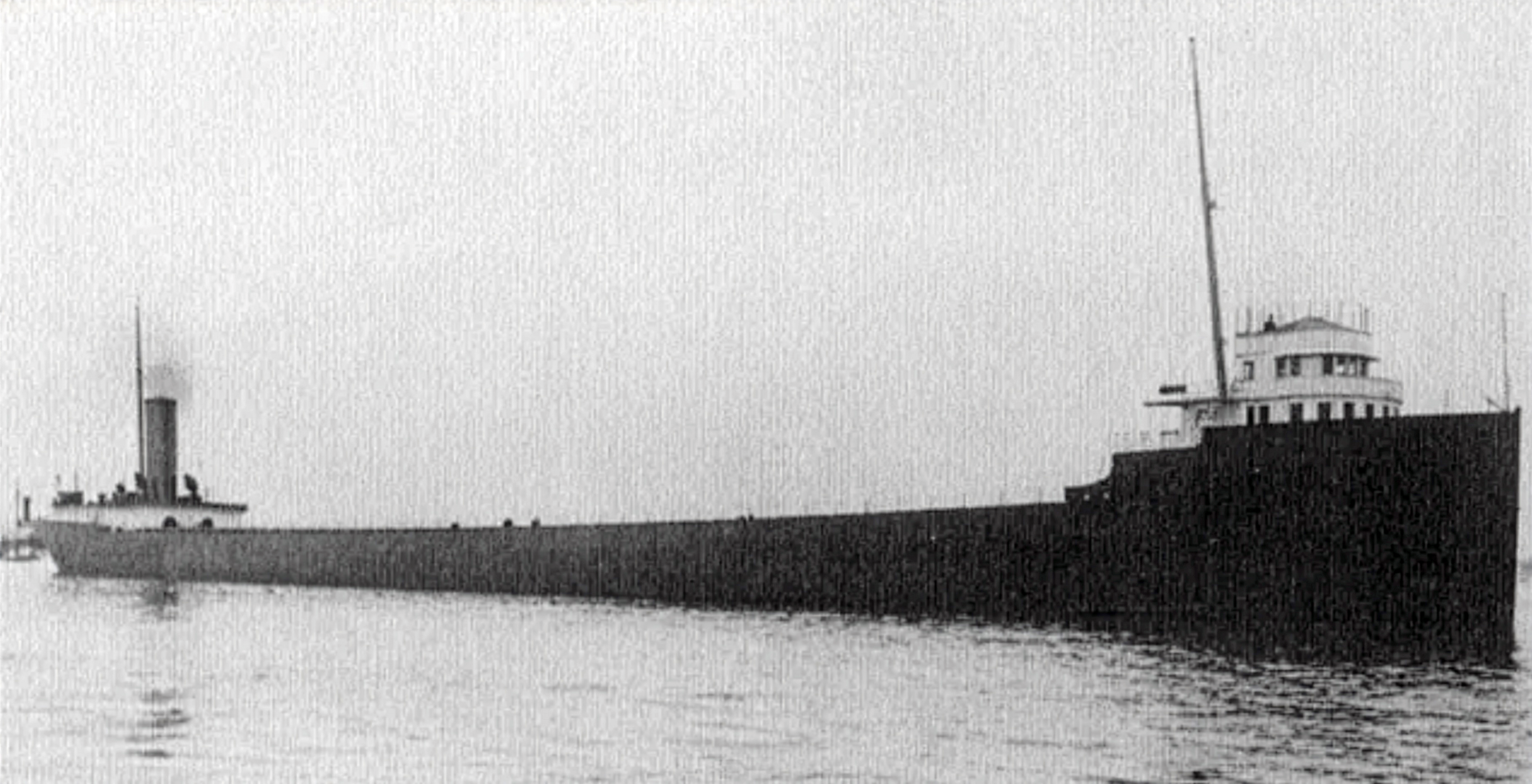
SS james C. Carruthers, 550 feet long sunk in the Great Storm of 1913.
At 550 feet long, the James C. Carruthers was the pride of the Canadian side. It sank after only 6 months on the lake.

SS James C. Carruthers – Last Giant Lost in the White Hurricane

  • Date shipwrecked: 9 November 1913, during the Great Lakes Storm (“White Hurricane”) of 1913.
  • Approximate location: Sank in Lake Huron; the wreck was finally found in 2025, lying upside down about 20 miles east of Harbour Beach, Michigan, in U.S. waters, although wreckage and bodies originally washed ashore on the Ontario side near Inverhuron.
  • Depth of the wreck: Roughly 190–200 feet (about 58–61 m), considered a deep/technical dive.
  • Cause (likely): Brand‑new 529–550‑foot Canadian freighter, lightly loaded with wheat, caught in hurricane‑force winds and 30‑plus‑foot seas; investigators now suspect it capsized or “turtled” in the storm, possibly after heavy icing made it top‑heavy.
  • Lives lost: All on board; most recent accounts and discovery reports consistently state 22 crew lost, though older Canadian gallery material mentioned 25.
  • Rescue/search attempts: During the storm, people onshore near Inverhuron reported hearing whistles and seeing distress rockets far offshore; afterward, wreckage and many bodies wearing lifejackets and heavy coats washed up along the Ontario coast, but the ship itself remained “missing” for over a century until side‑scan searches located the upside‑down hull in 2025.

Why Great Lakes Shipwrecks Still Fascinate Us

Shipwrecks have captured the imagination for hundreds of years, no matter where they have occurred. With literally thousands of ships lost on the Great Lakes over the past two centuries, the stories and discoveries of these lost vessels are ongoing. Many wrecks still remain undiscovered. Here are some useful links to websites with more information on this fascinating subject:

The Great Lakes Shipwreck Museum

The Reddit Thread on Shipwrecks

The Great Lakes Storm of 1913

Shipwrecks of the Great Lakes

Register of Wrecks and Casualties, Inland Waters 

About Gerry Cariou

Gerry is the Executive Director of Ontario's Sunset Country Travel Association and is an avid fisherman and nature photographer. Gerry has been writing about Sunset Country's varied travel experiences for over 20 years and lives these experiences year-round in Kenora, Ontario.

Recommended Articles

Northern Ontario’s Most Unique Stays

Cabins, domes, retro cottages, historic lodges, and lakeside escapes worth the road trip.

U-Pick Berries and Fruit in Northern Ontario

You'll find strawberries, blueberries, apples, flowers, and more at these top spots from Thunder Bay to North Bay, and beyond!

The Best Ice Cream in Northern Ontario: Where to Go This Summer

A guide to local ice cream shops, lakeside trucks, and waterfront cones worth the stop.

Fueling the Adventure: A Sweet Butter Tart Road Trip Through Northern Ontario

From Thunder Bay to North Bay, taste your way across Northern Ontario on this road trip dedicated to its most iconic treat—the butter tart!

Top 10 Things To Do in Northern Ontario

Pictographs, Niagara of the North, the famous Cup and Saucer Trail, and more!

See the Leaves Change: Fall Colour Report Ontario 2025

Autumn in Ontario is one of the most beautiful sights in the world. Here’s how to plan a spectacular viewing experience.

7 Amazing Northern Ontario Islands You Must Visit

These remote northern spots often require a boat to reach, but the journey is well worth it.

The Agawa Rock Pictographs

Discover ancient Indigenous art on Lake Superior.

6 Dark Sky Preserves in Ontario

Go here to see meteors, the International Space Station, Northern Lights, and the Milky Way.

Best Vinyl Record Stores Ontario (That aren't in the GTA)

Add these northern gems to your bucket list.

The World's Smallest Record Store Is Not Where You'd Expect

In a converted meat trailer off the Trans-Canada Highway lies a tiny record store named after a walrus penis.

The Northern Ontario Beer Trail: 8 Essential Stops For Beer Lovers

Cheers to exploring the north, one sip at a time!

12 Times TikTok Was So Northern Ontario

The North Gives Good Content

7 Species Worth Fishing for in Ontario

How many of these species have you caught?

10 Sights To See By Motorcycle In Northern Ontario

These stops should be on every motorcycle bucket list.

A Road Trip to Red Lake

Read the Great Big Northern Ontario Story Contest winner about friendship, fishing, and the things we do when we're young.

The Eagle

Pride Events in Northern Ontario 2025

Northern Ontario celebrates its 2SLGBTQI+ community this summer. Here's your calendar for everything Pride-related in the region.

How to Book a Campsite in Ontario

Need to book a campsite and not sure where to start? We got you.

9 Films About Northern Ontario You Have To Watch

How many of these movies have you seen?

7 Stompin’ Tom Connors Songs About Northern Ontario

How many of these Ontario spots have you visited?

17 Amazing (and Random) Vintage Ontario Tourism Ads That Will Definitely Make You Want to Travel This Summer

17 fun favourites from Ontario's advertising past.

10 Amazing Facts About The Trans-Canada Highway

How much do you know about the highway that unites Canada from coast to coast?

Search The Best of Northern Ontario