Indigenous Artists You Should Know from Northern Ontario
From the founders of the Woodland School to contemporary artists designing Olympic uniforms, these are the Northern Ontario artists who shape Canadian visual culture.
The artists who made it are from Northern Ontario. Specifically, from communities across what is now called Northern Ontario, from Manitoulin Island to Red Lake to Upsala to the shores of Gichigami.
The Woodland School
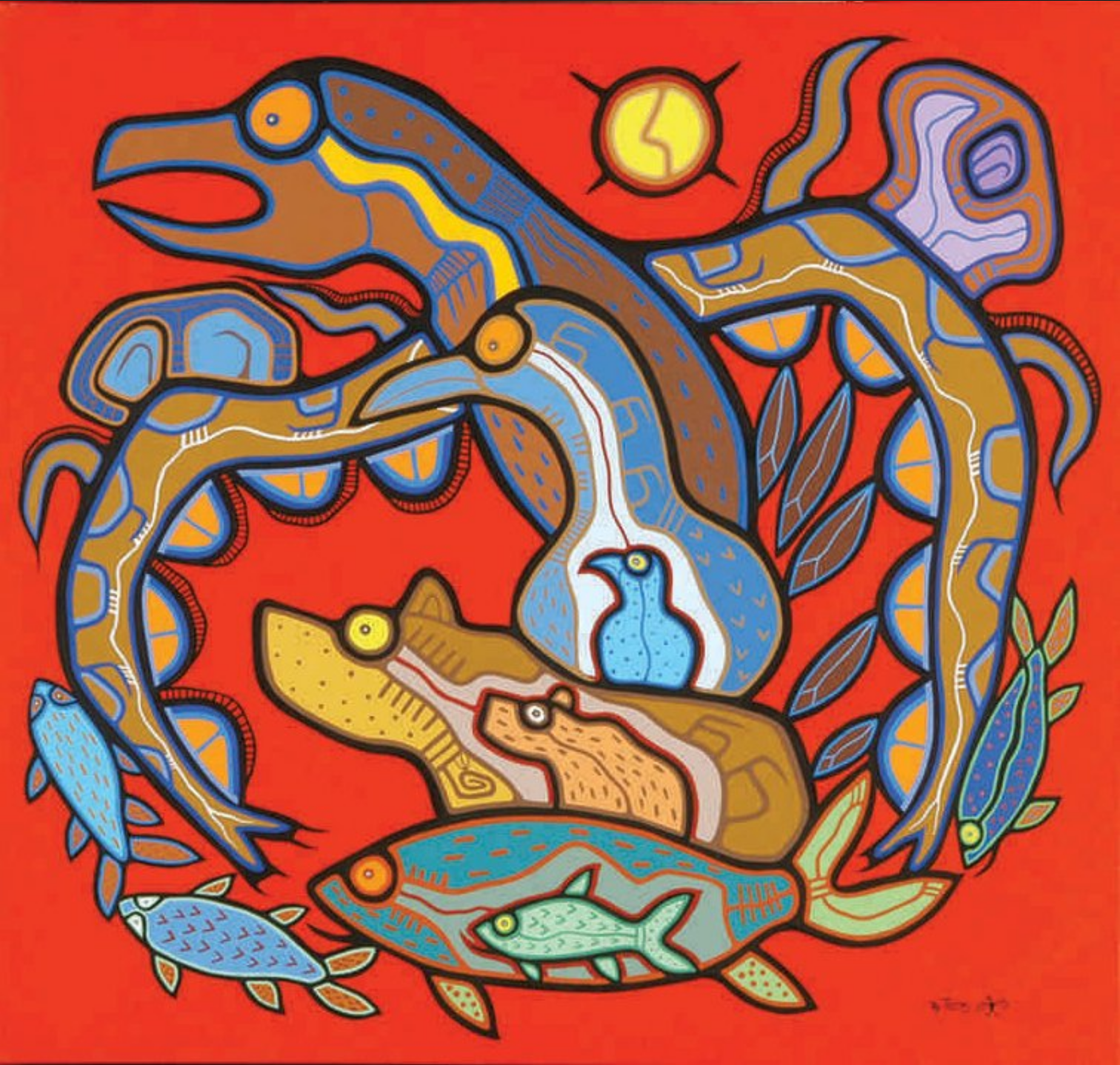
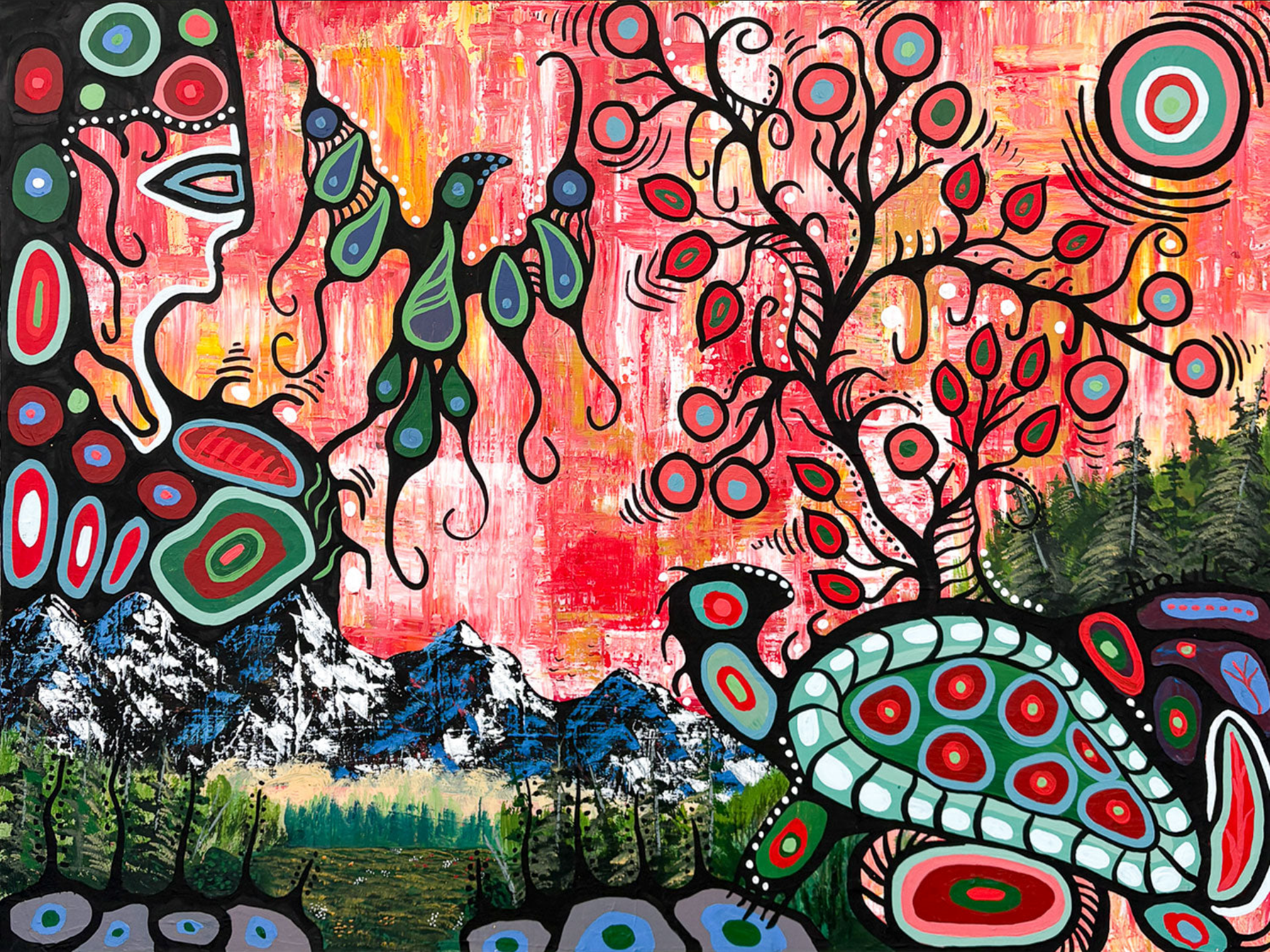
In the early 1960s, a young Anishinaabe painter named Norval Morrisseau began making work unlike anything galleries had shown before — with bold black outlines, luminous colour, x-ray imagery that revealed the spiritual life of animals and people, and visual language pulled directly from Anishinaabe teachings, it made Indigenous art accessible to a wider audience.
Morrisseau was from Bingwi Neyaashi Anishinaabek, in Northwestern Ontario. His debut exhibition in Toronto in 1962 sold out on opening night. By his death in 2007, his work was held in the permanent collection of the National Gallery of Canada, and he was widely recognized as the founder of what became known as the Woodland School of Art.
Carl Ray from Sandy Lake First Nation was another founding member of the Professional Native Indian Artists Inc. — the group that became known informally as the Indigenous Group of Seven. Active through the 1960s and 70s, his Cree-influenced Woodland paintings found their way into national exhibition spaces despite a career that ended far too early with his death at age 35.
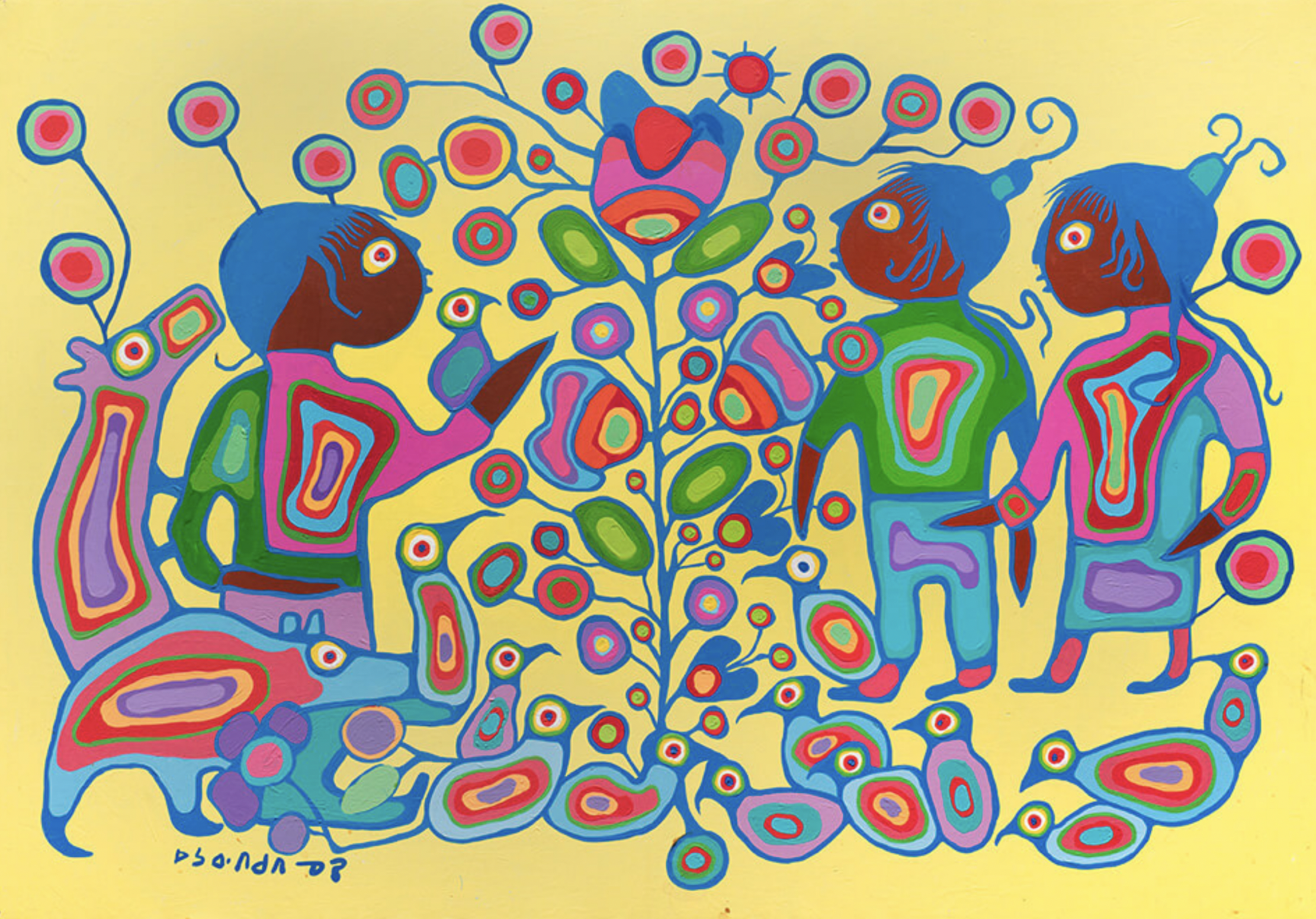
Daphne Odjig, Harmony and the Universe, 1986, Gallery Gevik // Norval Morrisseau, Children with Tree of Life, ca. 1980–85, Art Gallery of Hamilton
Foundational Artists: The Second Wave of Woodland Art
A generation of artists from communities across Northern Ontario took up the visual language of the Woodland School and made it their own.
Northwest Ontario
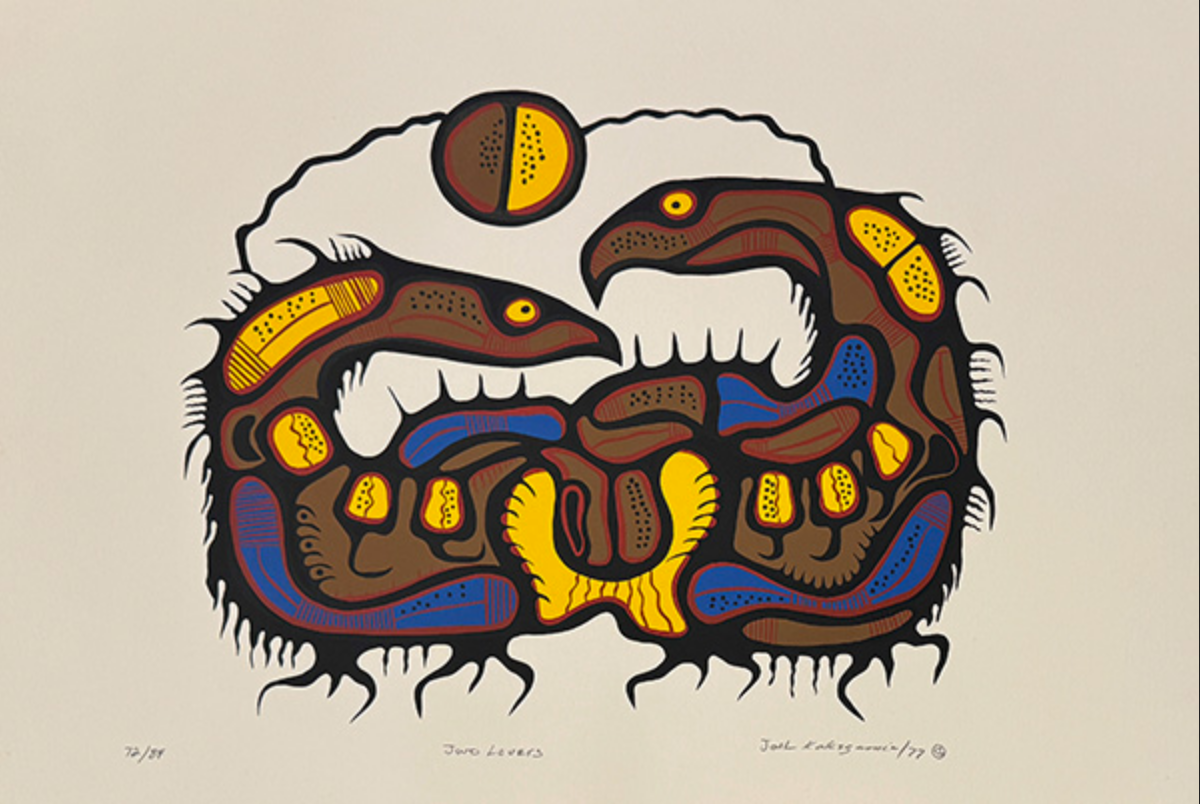
In Red Lake, the Kakegamic family were building a commercial infrastructure for their art practice. In 1973, Joshim Kakegamic co-founded the Triple K Co-operative with his brothers Goyce and Henry and their father: one of the first entirely Indigenous-owned print studios in Canada. Over roughly seven years, the Co-op produced more than 180 limited-edition print editions, distributing Woodland art to collections in Canada, England, and Germany. The structure of the Co-op gave Indigenous artists creative and financial control over their own work, which was not always the case at that time. Joshim's prints ended up in the Royal Ontario Museum and the McMichael Canadian Art Collection. His art is available for purchase at several galleries in Toronto, and from Ahnisnabae Art Gallery in Thunder Bay.
Roy Thomas was known for expressive colour and spiritually focused imagery within the Woodland School tradition. His paintings explore vision, transformation, and personal experience. He was the subject of Vision Circle: The Art of Roy Thomas, a retrospective exhibition organized by the Thunder Bay Art Gallery that toured with more than 40 of his works from 1965 to 2002. His former Thunder Bay studio is now Ahnisnabae Art Gallery, run by his wife Louise Thomas, who continues to exhibit his work alongside other Indigenous artists.
Leland Bell,alsofromWikwemikong Unceded First Nation, is a painter, musician, and language keeper whose practice is rooted in the Three Fires Midewiwin tradition. His spirit name is Bebaminojmat; he is of the Loon Clan. Bell came of age during a formative moment for Woodland art on Manitoulin Island — as a young artist he was mentored by members of the Indigenous Group of Seven, including Tom Peltier, at the Manitou Arts Foundation on Schreiber Island in 1972, absorbing the visual language of the first wave while developing a style distinctly his own.
Beyond painting, Bell has spent decades writing songs in Anishinaabemowin since the 1980s, collaborating with Shirley Cheechoo and Blake Debassige on music for film projects. Bell has exhibited across North America and Europe and his work is held in prominent collections on both continents. He has also taught and led workshops across the continent, passing the tradition on in the same way it was passed to him.
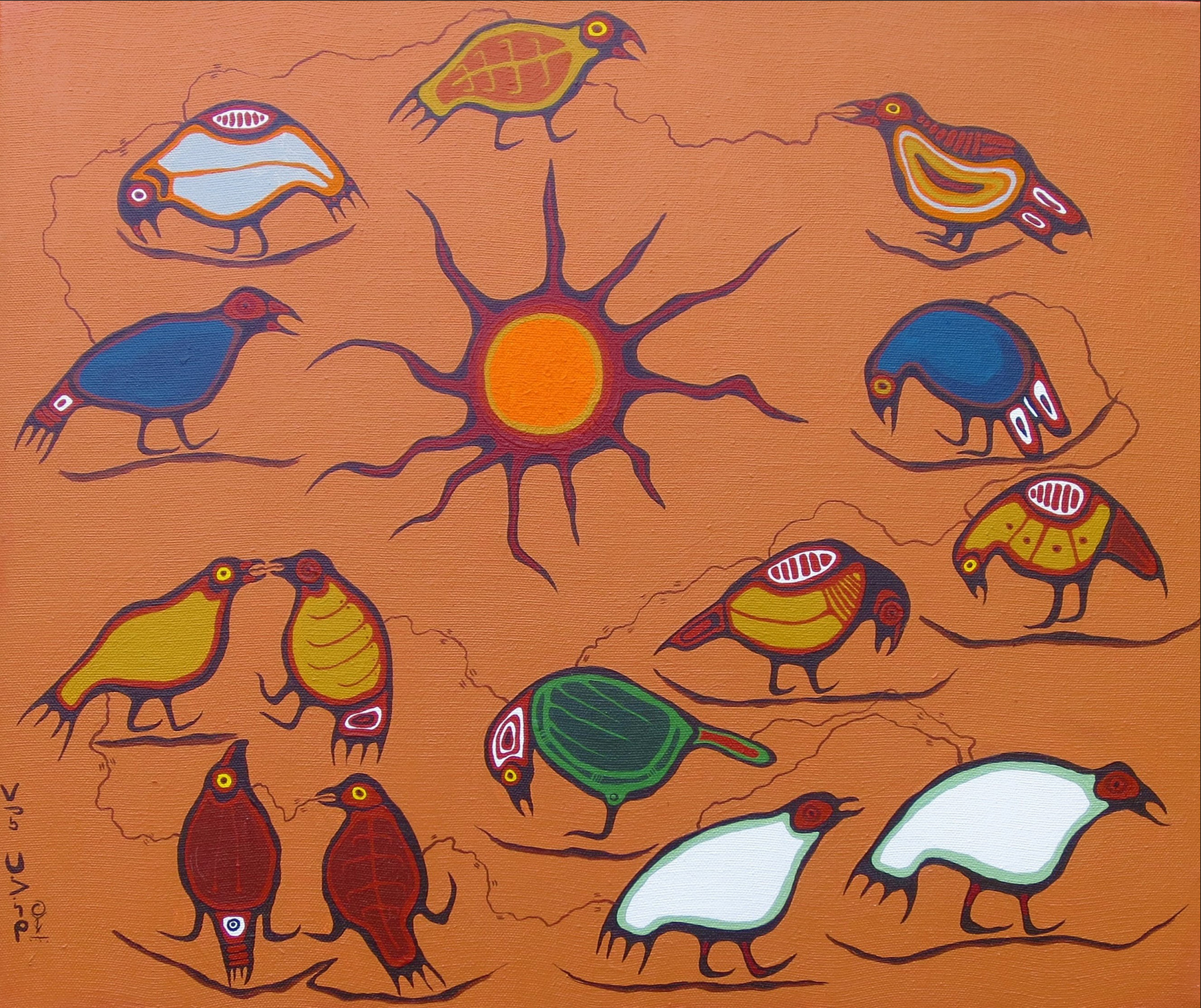
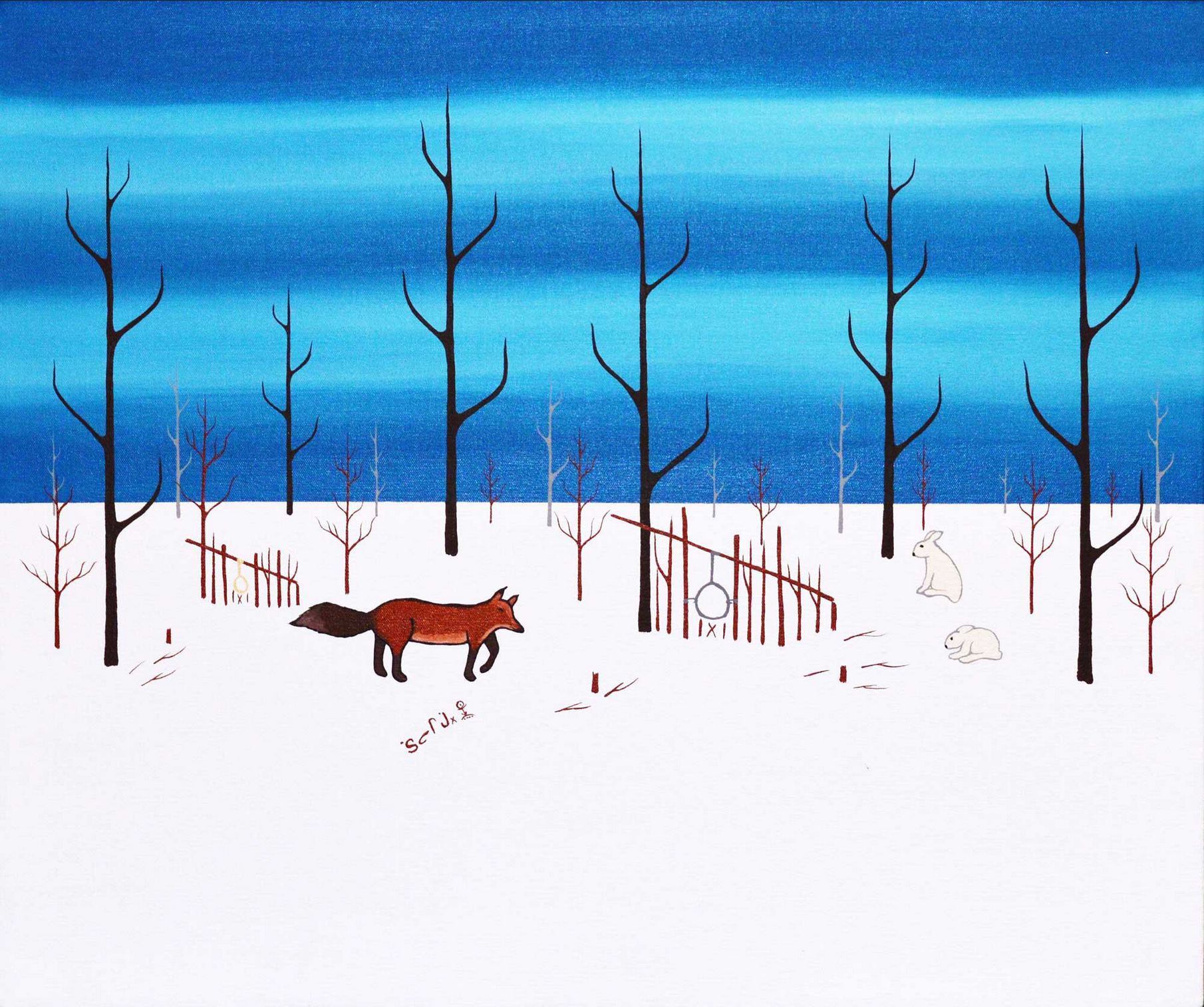
Joshim Kakegamic, Two Lovers, 1977, Gallery Phillips // Roy Thomas, New Year, 2002, Bearclaw Gallery // Blake Debassige, Birds Eating, 1977, Gallery of Native Art
Multi-Disciplinary Visionaries
Dr. Shirley Cheechoowas born onMoose Factory Island, lived on a traditional trapline as a child, and moved to M'Chigeeng First Nation where she married Blake Debassige. She is an artist whose impact is hard to overstate. Her visual work, referencing moments of her trapline childhood, has been commissioned by UNICEF, Amnesty International, and Toronto's Hospital for Sick Children. She co-founded the Debajehmujig Theatre Group on Manitoulin Island in 1984, one of the most important Indigenous theatre companies in Canada. She also founded the Weengushk Film Institute, an Indigenous-led film school that has launched filmmakers from across Northern Ontario and beyond.
Bonnie Devine from Serpent River First Nation is a painter, sculptor, writer, and educator whose practice draws on Ojibwe mythology and storytelling across an unusually wide range of forms — drawing, painting, sculpture, site-specific installation, performance, and video. Her solo exhibition The Tecumseh Papers showed at the Art Gallery of Windsor in 2013, and her work has appeared alongside other Indigenous artists in Anishinaabe Artists of the Great Lakes at the Art Gallery of Ontario.
Beyond her studio practice, Devine has spent decades building infrastructure for Indigenous art education. She is an Associate Professor at OCAD University and the founding chair of its Indigenous Visual Culture Program — one of the first of its kind in Canada. In 2021, she received a Governor General's Award in Visual and Media Arts.
Rebecca Belmore is from Upsala, Ontario — a small community between Thunder Bay and Dryden — and in 2005 she became the first Indigenous artist ever to represent Canada at the Venice Biennale, the world's oldest and most prestigious international art exhibition. The work she showed there, Fountain, was projected through a curtain of falling water in the darkened Canada Pavilion. She holds a Governor General's Award for Visual and Media Arts, and her work is in the permanent collection of the Art Gallery of Ontario.
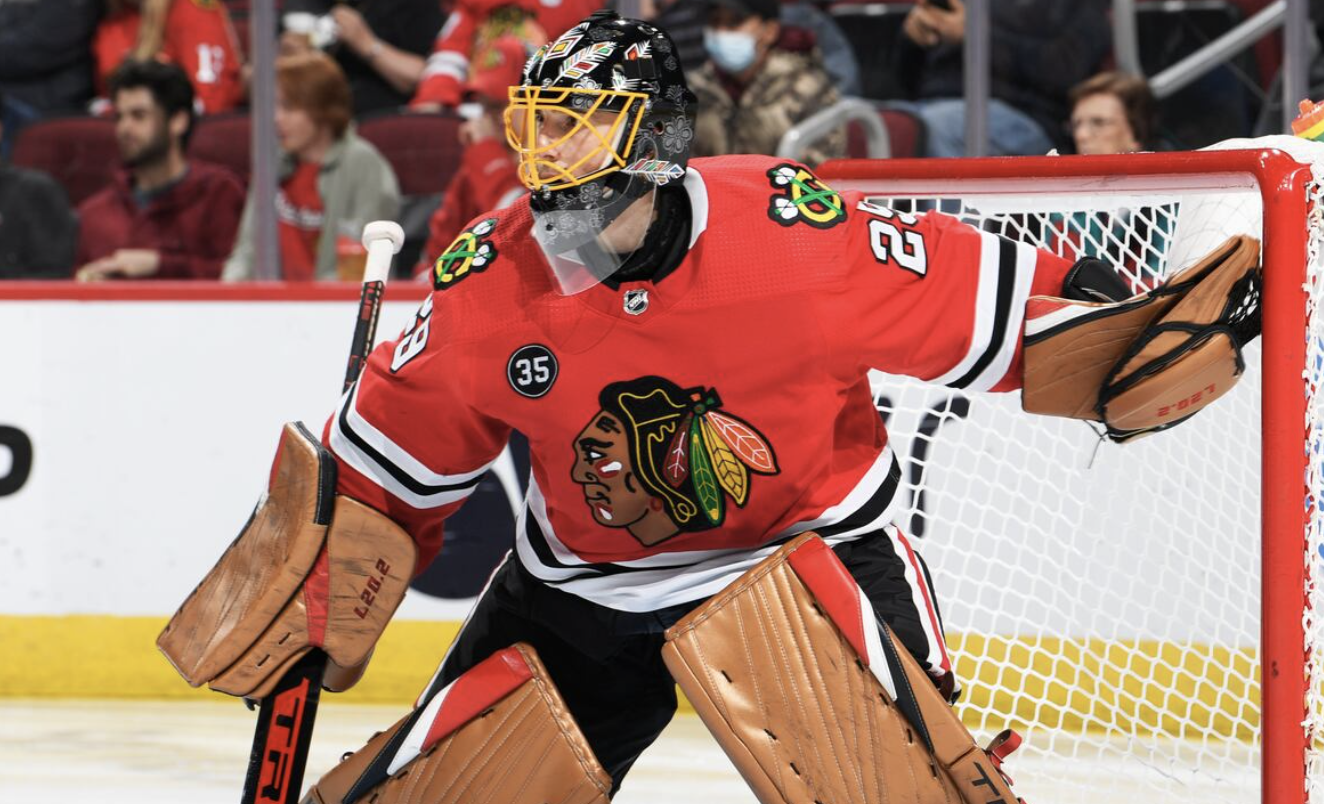
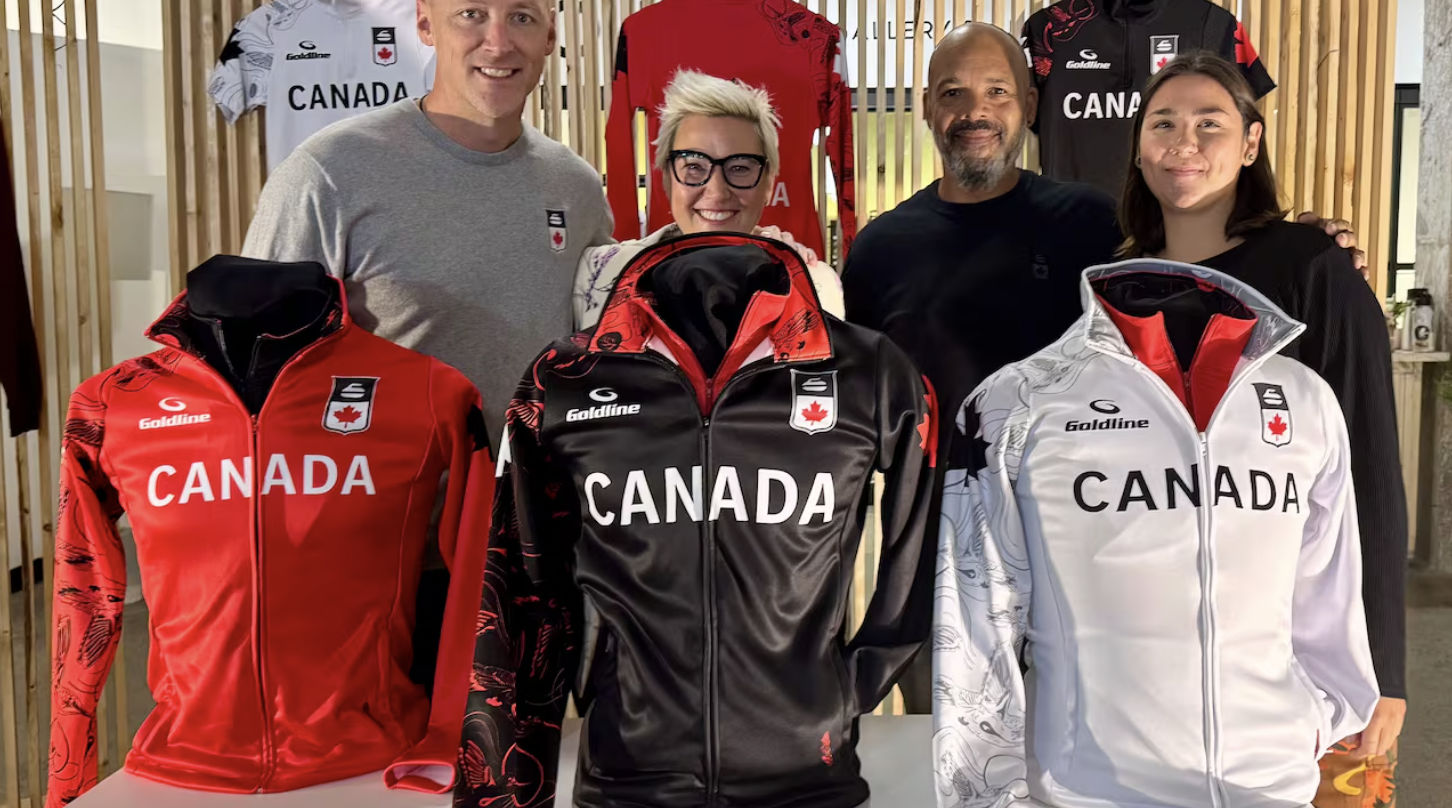
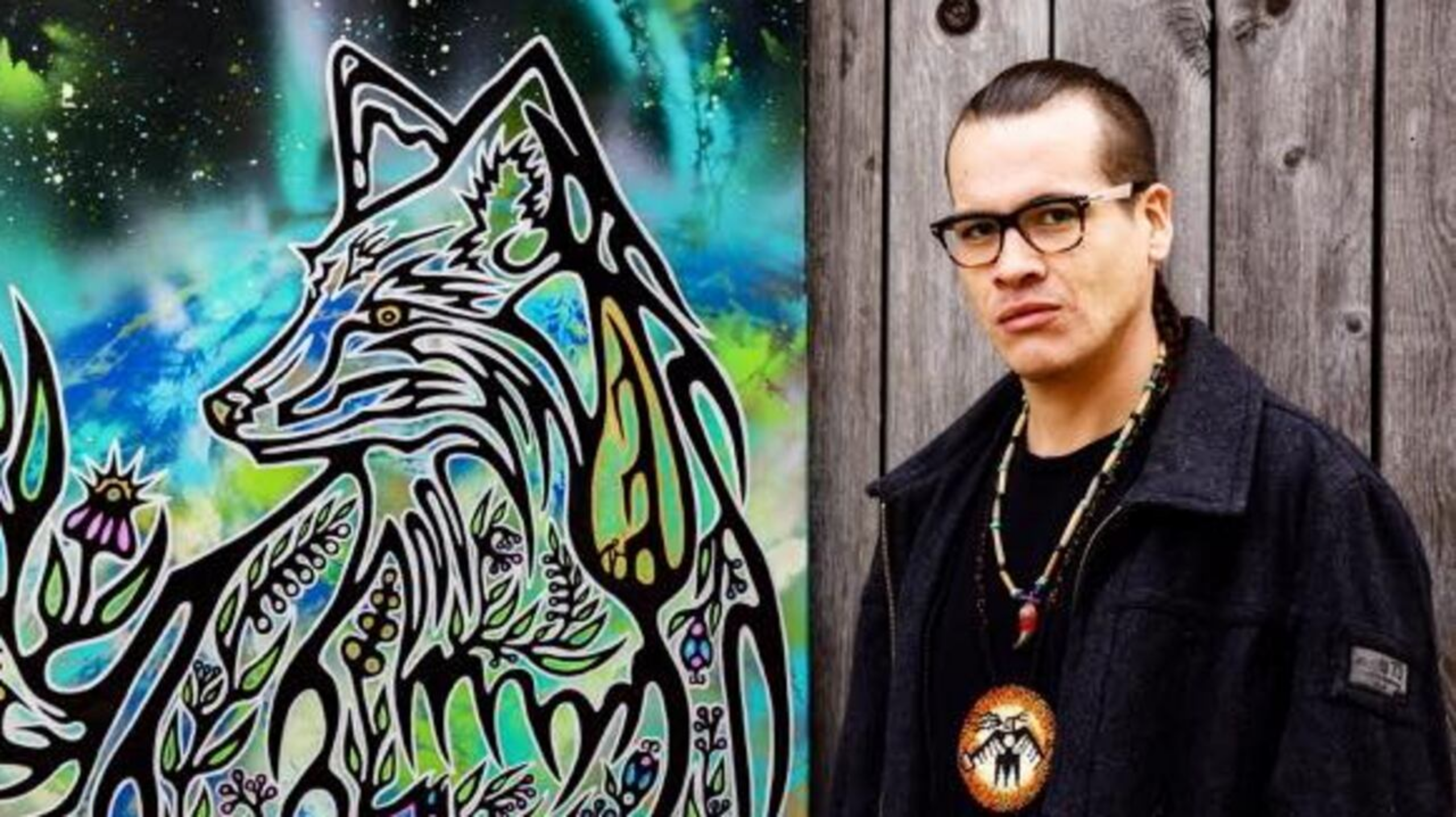
Patrick Huntergrew up in Red Lake seeing Morrisseau's original paintings on the walls of buildings around town. He moved to Toronto to build a career, and build one he did: his Woodland-influenced designs have shown up at CBC headquarters, Toronto City Hall, TD and BMO bank branches, and the Ontario Trillium Foundation. In 2022, he designed the Team Canada curling uniforms worn at the Beijing Winter Olympics — the four sacred medicines braided down the sleeves, seven trees on the torso representing the seven grandfather teachings, a geometric maple leaf on the back. He also designed goaltender Marc-André Fleury's mask for the Chicago Blackhawks.
Shelby Gagnon, a 2-Spirit Anishinaabe/Cree artist from Aroland First Nation and now based in Thunder Bay, was commissioned to design the Team Canada curling uniforms for the 2026 Milano-Cortina Winter Olympics. The design is built around a hummingbird — a visitor from the spirit world — with water elements woven through a reimagined maple leaf.
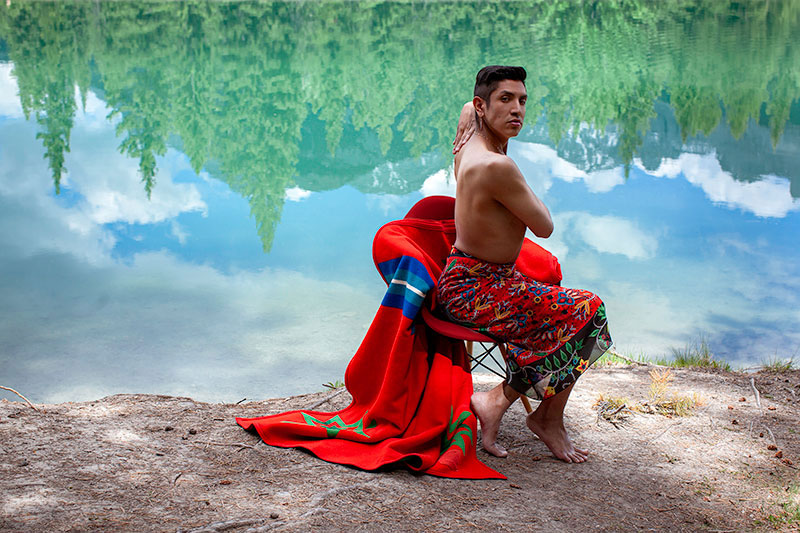
Nadya Kwandibens, from Animakee Wa Zhing #37 First Nation, founded Red Works Photography in 2008 with a single intention: to show Indigenous people in ways that are alive, contemporary, and real. Her Red Chair Sessions portraits have hung on a billboard in downtown Toronto during the CONTACT Photography Festival and shown at the Thunder Bay Art Gallery. In 2023, she was appointed Photo Laureate for the City of Toronto, the first Indigenous person to hold the position and the only role of its kind in Canada.
Cody Houle from Saugeen First Nation works in painting and mixed media with a practice grounded in place and community. His work has appeared in Indigenous-led exhibitions and regional gallery shows across Northern Ontario.
Welcome to Northern Ontario, Canada! Bigger than Texas, wilder than the west, more welcoming than a campfire in October, Northern Ontario is like no place else. Sunset Country is famous for its spectacular fishing lakes, Superior Country has friendly towns and a superior coastline, Algoma Country has bucket list drives and epic outdoor adventure, and the Northeast provides excellent vacation destinations close to Toronto and other large urban centres in Southern Ontario.